Dadu Aur Madak
Agra| As
I have mentioned earlier, we had lost our camera just two days after
our visit to Agra. I can't begin to tell you how depressing is the
thought
of losing photos of two of the most incredible places we have ever
seen, Khajuraho and the Taj Mahal. The truth though is that none of the
photos I have ever seen capture the qualities of the Taj Mahal. It
cannot be blamed on camera equipment, and it is not even the fault of
my meager camera skills. The Taj Mahal is simply a place that has to be
experienced in person. First of all, video cameras are only allowed as
far as the platform right inside the gate. You are allowed to take
video from a distance of about one-and-a-half football fields away, and
then you have to return to the gate and put your video camera into a
locker. No tripods, camera stands, or monopods whatsoever are allowed
into the grounds. The best photo time--or so every guide book says--is
at sunrise when the translucent marble changes colors as the sun rises.
Unfortunately, that post card quality photo remains elusive, sullied by
the hundreds and hundreds of tourists who jockey for position to have
their unattractive selves included in the photo. Those pristine
post-card photos are taken when nobody else is present with the best of
large format cameras and filters. Another thing that
fouls the early morning shot is the pall of diesel-fouled air that
veils Agra as it does all Indian cities. Agra has taken measures to
ameliorate this by banning vehicular traffic near the complex, but this
barely constitutes a Band-Aid on a gaping wound. For all of that, the
Taj Mahal has faired very well, and it's milky whiteness and
semi-precious inlays are remarkably well preserved in spite of being
pawed mercilessly by hordes of tourists. |
|
 |
|
| Above
is the southern of the three gates that enter the Taj Mahal grounds.
The massive sandstone structure is over one-hundred feet tall, and has
the same marble with its semi-precious gemstone inlays surrounding the
arch as is on the Taj. |
|
 |
|
| The
early morning haze masks the milky blue quality of the translucent
marble in the photo above. Below, as the sun warms and the haze begins
to dissipate the changing light begins to give
the building a rosy hue. Unfortunately, on the day of our visit the
reflecting pools were empty. |
|
 |
|
 |
 |
| An
even more dramatic depiction of the Taj's changing hues are the two
shots above. The Taj is flanked east and west by identical strucrures.
Both photos were taken with the same point and shoot camera with
identical settings. The photo at left was taken from the eastern
structure, an exact replica of the western side's mosque. You will note
the golden hue of the early morning sunlight. In the photo at right
from the western mosque the sun pouring in the mosque's arch puts its
glow on the archway while the side of the Taj itself that is visible
has the sun behind it and is in the shade. It is decidely bluer. The
photos also reveal the Taj's perfect symetry and even the eastern
structure, the jawab, was constructed to maintain that symetry. |
|
 |
|
| The
photo above is of the western mosque. Either of the structures would be
marvels in their own right if not overshadowed by the beauty of the Taj
Mahal |
|
 |
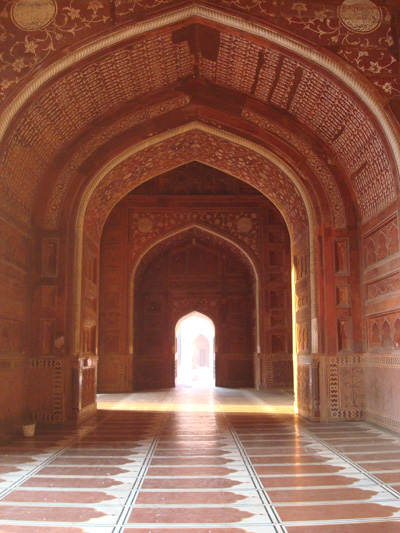 |
| The
mosque's main portico is of a massive size. Inside the main archway it
is flanked on both sides by open galleries like the one at right. |
|
 |
 |
| All
around the base of the the entryways and porticos of the Taj are these
marble carvings surrounded by inlaid garlands of semi-precious stones.
(left) The photo at right shows the carving. The carving is not applied
to the marble, rather it is the field that is removed leaving the
design raised. The photo below at left shows the detail on one of the
leaves, while the one below right shows some detail of the inlaid
garland. The garland is almost seamlessly inlaid into the marble and
includes stones of carnelian, Indian jade, jasper, lapiz-lazuli,
malachite, and onyx. Just the scope of the undertaking is phenomenal,
not to mention the uniformity of the workmanship. |
|
 |
 |
| By
far the most beautiful part of the Taj Mahal has a prohibition on
photography. The interior houses replicas of the tombs of Shah Jahan
and of his second wife Mumtaz Mahal in whose memory the Taj was
erected. She died in childbirth, her fourteenth. The tombs are viewed
through chin high marble screens. The "screens" are an intricate floral
lace carved in two inch thick marble. The inlays that border the
screens are simply indescribably beautiful. The inlays challenge the
imagination and are said to contain forty-three different types of
semi-precious stones. |
|
 |
 |
| The
Taj's four entryways are bordered with Urdu script. So much attention
is paid to detail that the lettering at the top has larger letters to
adjust for the longer distance from the eye at a normal viewing angle.
(left) At right is the obligatory tourist photo. We resisted the
traditional motorcyclists' need to somehow get the bikes into the photo. |
|
 |
|
| Agra
also has a pretty impressive fort, but let's face it, we were here for
the Taj Mahal. The fact is that in Northern India almost every major
town has fortification of one sort or another, but more on that later.
We did enjoy one other experience of note in Agra though. Our most
entertaining evening in Agra (maybe our most entertaining evening in
India so far) did not involve the Taj Mahal at all. One evening we
visited a brand new western style shopping mall in Agra. It was a
four-story building surrounding an atrium complete with a Cineplex on
the third floor. The entertainment was at the expense of local India
women who had come to the city but had never seen an escalator. It was
fucking hilarious. Invariably the husband would get on confidently and
proceed to the next floor while the wives would wait at the bottom
contemplating the endeavor. Occasionally they would touch the hand
railing tentatively, quickly drawing their hands away when they
realized it was moving also. Then they would muster the courage to
approach, usually trying to coax the children to try it first. All the
while the husbands would be at the top shouting encouragement. After a
while they would get close enough to perch a hesitant foot hovering
above the ever retreating steps. Then they would begin to sway the foot
forward and back trying to get a sense of timing. Those of them who
finally got up the nerve to place the first foot were ultimately drawn
into the beginning of an involuntary "splits" before they would finally
snap the back leg forward to catch up with the rest of their body. The
dismount was no less comical. As if that wasn't enough, almost as
though on cue, Agra experienced one of the daily power blackouts that
occur everywhere in India on a daily basis. It seems as though it never
occurred to the unwitting victim that the escalator had simply turned
into a flight of stairs. We had come to this mall on the outside chance
that they might have a movie in English. They did not, but we ended up
with entertainment that you couldn't purchase at any price. |
|


