Dadu Aur Madak
Bandipur| Although
the trip from Kathmandu to Pokhara is an easily doable 230 kilometers we opted for
a stop in the small village of Bandipur about two-thirds of the way
there. About fifty kilometers out of Kathmandu we had our first
encounter with the Maoists. We had been reading about this situation
for some time now. What we are talking about is a tactic used by the
Maoists that originated with trekkers. A group of young men with red
armbands and hammer and sickle flags will stop tourists asking for a
donation or occasionally a toll to pass through their region. Once you
have contributed they will provide you with a formal receipt that they
will stamp paid. The first thing they do though is hand you a
typewritten page explaining that this is a popular movement that has
support of the people, and that it is actually the government in power
that is responsible for the occasional bombings that take place in
order to blame it on the Maoists. In many regions they do in fact have
the support of working people. They are pushing for the dissolution of
the monarchy. They typically ask for a set amount for their "donation",
and if you refuse they can appear to be very menacing. They are
particularly aggressive with tour operators, who will generally cough
up rather than risk damage to their support vehicles or equipment. This
is especially true with rafting and trekking outfitters where the
support vehicle is their lifeline. They ask for a per-head per-day
amount. The amount typically mentioned for trekkers is $15
per day. Some people will negotiate while others simply
refuse to pay. The latter is not usually the best option if you are a
trekker on foot. Especially if yours is a small group. Tour operators
generally just pass the cost directly on to their customers. Many
operators though that are just carrying passengers between towns with
pre-arranged hotel stays will refuse the high suggested price, offering
a lump sum instead. Unfortunately the "donation" tactic has been taken
up by teenagers seeking contributions for local "projects" like soccer
balls, or a meeting hall for teens or what have you. There is always a
rubber stamped receipt involved making everything official. We had
already discussed staying close to one another in the event of one of
these encounters, and had been advised by Nepalis to carry only a few
small bills in our pockets. The bottom line is that most of these
people are just kids. Incidents of any real violence being
reported are extremely rare. On the first occasion, there were a
half-dozen kids stopping cars on our side of the road, and another
half-dozen about a 100 feet down the road stopping traffic coming from
the opposite direction. They handed me the formal explanation, and
while I was reading it half of the group approached a van full of
Indian tourists that had pulled up on our left. When the van attempted
to ease by without paying the three kids in front of our bikes quickly
turned their attention to the bigger fish. As soon as they did I
signaled Karen and we drove off without incident. |
|
 |
|
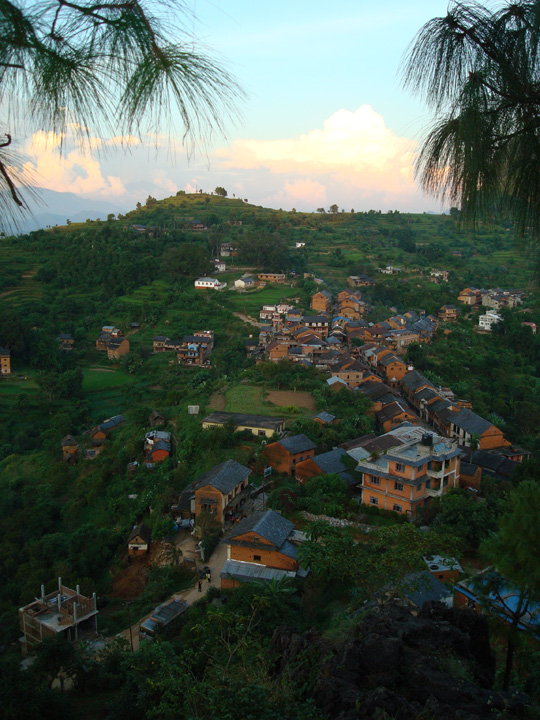
| Bandipur
is a magical little town whose location just off of the main tourist
track has preserved its charm. It sits about 8 kilometers off of the
road that runs from Kathmandu to Pokhara and is reached by a perfect
single lane blacktop that switch backs up the mountain. The main part
of the town snakes along a ridge top overlooking terraced valleys on
either side. The town has practiced amazing restraint in maintaining
the small town charm and resisting the temptation to turn it into
just another cheesy tourist trap. Vehicle traffic is allowed only as
far as the building in the bottom center of the photo. Most of the
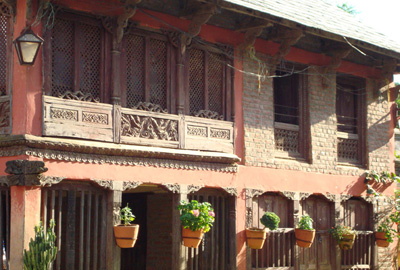
guesthouses are on the straight section and are in buildings of 18th
century Newari architecture. Most have carved windows and eaves with
slate roofs. The interiors are simple and rustic with few amenities but
details of craftsmanship are evident everywhere. The town only has
electricity until about 9:00 at night. Breakfast is included at most
guesthouses which serve delicious regional meals. The village fathers
have shrewdly chosen to reinvest tourist dollars into improving the
town's infrastructure while maintaining its small town ambiance. The
pedestrian mall is almost completely paved in pink sandstone
flagstones, and local men were working on the remaining portion while
we were there. It is kept immaculately clean. Guesthouses send someone
out with a rubber tired flat truck to carry in people's baggage down
the pedestrian mall. Part of the reason for stopping here was that
until now we had only stayed in hotels owned by the Sakya family. We
had experienced such amazing hospitality that we were curious as to
whether that hospitality extended to other parts of Nepal. Bandipur met
or exceeded all of our expectations. The people were wonderfully open
and friendly and were helpful without having their hand out which is
frequently the case in India. |
|
 |
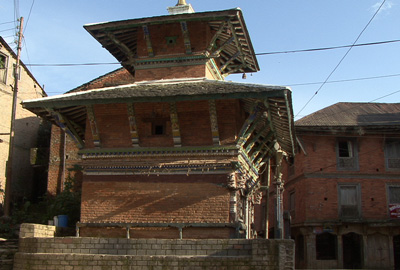 |
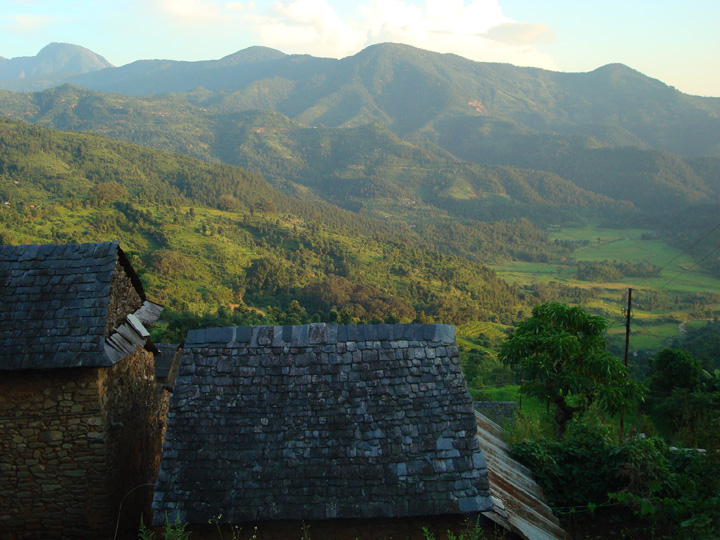
| The
architecture is notably similar both on this business on the left, and
this temple dedicated to Durga on the right. There are a few buildings
like those below that show an even earlier architectural style and are
made entirely of stone. |
|
 |
|
 |
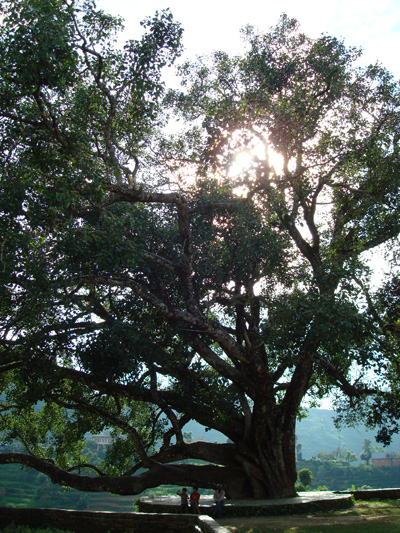 |
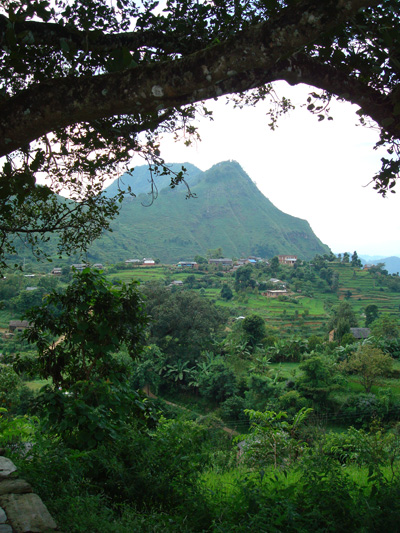
| Left:
A handful of houses dot the landscape of terraced fields away from the
main street. At right: Trees seem to hold a place of special reverence
for Nepalis. Typically roadways move to accommodate large old trees and
not the other way around. It is not unheard of to see roads go down to
just one lane when there is no way around a big tree. Large trees like
this one often have a paved "bench" built around them to provide a cool
and comfortable place for people to gather. |
|
 |
|
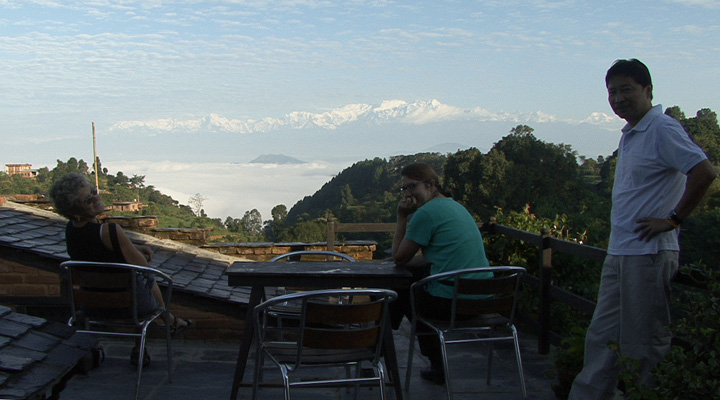
| Our
room was a top floor garret that opened onto the slate roof of the
rooms below. We woke the first morning to find the valley below us
completely blanketed in clouds with a clear view of the Annapurna range
above it. The folks joining Karen are a Canadian expat living in Saudi
Arabia, and her Nepali partner. They are tour operators that run tours
in Nepal, Tibet, Sikkim, and Bhutan mostly for people from British
Columbia. She also runs a few tours in the Middle East and in Turkey.
They had come to investigate Bandipur as a stopover destination for
tours traveling by road from Pokhara to Chitwan. They proved to be a
wealth of information about travel in the Himalayas. |
|


