Dadu Aur Madak
Bhavnagar & Baroda| On
the way to Baroda from Diu we decided to pass through Bhavnagar. From
our point of view their was not that much of interest there except for
the fact that the area is known for what they refer to as a
"ship-breaking" yard. The yard, which is actually in Alang about 50
kilometers south of Bhavnagar keeps a crew of 20,000 working around
the clock in what is India's, and perhaps the world's, largest
operation of this kind. This crew dismantles everything from
super-tankers to battleships completely by hand. Unfortunately it
proved impossible to see for a number of reasons. Admission is only
granted through Gujurat's Port Trust which is inland in Ahmedabad
nearly 100 kilometers away. Even then you must present them with a
reason, and photography or filming is strictly prohibited. The reason
for the super tight security is that Greenpeace back in 2002 gained
access posing as scrap buyers. Their subterfuge, used to gain support
for their protests about the hazards to workers and the environment
there, has made it next to impossible to have permission granted. At any rate there was a more immediate obstacle in my case. On the evening before leaving Bhuj, I had a mosquito go into my eye while riding the motorcycle. By my the next morning my eye was swollen and puffy. It didn't seem so bad, but the next morning in Bhavnagar, I woke with a bone crushing fever. I worried that it was starting out like a bout of dengue I had nearly forty years ago, and it kept me in bed for three days. Glad that it had turned out not to be dengue we decided to press on on the fourth day, having seen absolutely nothing of Bhavnagar except the inside of our hotel room. On the way from Bhavnagar to Baroda is an important site from the Harappan culture that dates back to 2500 BC and is directly linked to the other Indus valley sites such as the one at Mohenjodaro in Pakistan. I'm sure to most people this is just another pile of bricks, but having studied this in school, it was kind of interesting to see real evidence of trade with cultures as far afield as Persia and Mesopotamia. There is a fine collection of clay seals that were used to seal parcels of merchandise for shipping. These have been found as far away as what is now Turkey. Many of them depict a single horned bull-like creature (a unicorn?). The writing on them has yet to be deciphered even though there are thousands of them in existence. The amazing thing though is the uniformity of the brick both within and between sites, and that some of the brick has faired so well, even though it is 4500 years old. Even more impressive is that this ancient culture contrived an elaborate system of lock gates which enabled them to use the nearby Sabarmati river to link them to the sea, making this perhaps the area's most important shipping port of its day. |
|
 |
 |
 |
 |
| Once
again it is the uniformity between sites that is most impressive, and
confirms this as being linked to sites from quite a distance. Clockwise
the photos show the distinctly grid like layout, which has been shown
to
have been broken into enclaves according to the work performed in each
area. Next we see an elevated platform of much larger proportions that
represents a position of authority. There are remnants of a communal
well as well as an area of communal bathing. And finally there was a
fairly advanced system of aqueducts. |
|
 |
|
| A
bit further along we stopped at a tea stall where we encountered
several of these sheep herders. They all wore a variation of this same
necklace. We tried desperately to determine the meaning of it, but
these people speak neither Hindi nor Urdu. There own language is a
tribal Gujurati. Of course the tea stall walla, an extremely friendly
type, insisted on getting into the picture as well (below left).
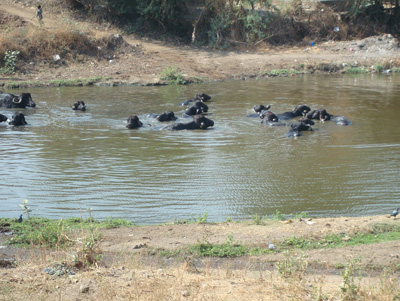
Shortly afterward, we saw this herd of water buffalo. You can just see
a young boy running up the road. After trying desperately to get them
out of the water, he started racing up the road apparently shouting for
help. |
|
 |
 |
| Having
finally reached Baroda we were to encounter what was for us the very
highlight of our trip to India. I had attended film classes and worked
on a few short films with my friend Soni back in San Francisco, and
when he learned of our plans to spend six months in India he told us if
we ever got to Gujurat state we should look up his family. Well,
following several emails when we finally got to Gujurat, Soni called
his family with a long list of things he thought we might like to see.
We contacted Soni's father with our arrival plans, but unfortunately,
on the day we arrived my fever had returned. We had some urgent service
issues that had to be attended to with the motorbikes, but other than
that, I was back in the hotel room stuck in bed. We were able to get
out and see a doctor, who sent me to be tested for malaria and
prescribed some drugs to take for it. The test proved negative, but I
still would keep breaking out with soaking perspiration for no reason.
On top of feeling bad, we had arrived in Baroda at the peak of marriage
season, and had to switch hotels after the first day. Apparently
astrological dates are important when planning a wedding in India, and
the 3rd of December was a very auspicious day for marriage so many were
planned on or near this date. After a few days I felt well enough to
venture out, and we called Soni's dad Navin Soni and said we would
come by for a short visit. A few words of clarity here might help out. I had seen my friend' s name on class lists as Prashant Soni, but everyone knows him simply as Soni. I thought that Prashant was his family name, so when I refer to Soni's family, I am actually referring to Prashant's family the Sonis. At any rate, when we went over for this short visit on Sunday afternoon, we found they had a whole evening planned out for us. Prashant's cousin Kiran is an administrator with Baroda's parks, and soon a car and driver came by to pick us all up to take us just outside of town to this magnificent park with these remarkable fountains. It is adjacent to a reservoir that supplies Baroda's drinking water, and both the park and the water system had been set up by a very forward thinking Maharaja. |
|
 |
|
| Here
the family poses with us in an evening shot in front of the reservoir
before going in to see the fountain concert. At left is Prashant's
cousin Kiran, who treated us like we were visiting royalty. Next to
Karen is Prashant's father Navin and his wife Rajshree
(Prashant's step-mother) and his half sister Chandni. |
|
 |
|
| No
single photo can do justice to the amazing multi-colored display of
this fountain that keeps time to a musical score. These displays take
place on Sunday evenings, and local families come out and sit on the
beautifully manicured lawns to watch. There are three displays each
Sunday, and there is another fountain that combines fire and water to
simulate a volcano. It is simply incredible. Afterward,
Kiran introduced us to the two men that operate each of the fountains. |
|
  |
 |
| It
turned out that the park that Kiran manages was just a short walk from
our hotel. As my health situation was failing to improve, Kiran was
kind enough to show Karen around the park, and arranged for me to meet
with another Soni family member, who was a doctor. This park in Baroda
is probably the most beautifully maintained park that we had found in
all of India. The landscape architecture is outstanding. At left, this
working floral clock (top) faces a rose garden, and at bottom is a view
of the band shell which is ringed by elegant bronze sculptures. Kiran
even introduced Karen to this magnificently mustachioed Head of
Security. |
|
 |
|
| This organized
mayhem is actually the motorbike parking lot at the Baroda Train
Station a few blocks from our hotel. Thanks to Dr. Ramesh Soni, who
repeated the malaria test and switched my medications I was starting to
feel a bit better. He told me that the medication the first doctor had
prescribed was probably responsible for my sudden outbreaks of
perspiration. We had passed this place, and I just had to go for a
closer look. There is apparently some method here. Bikes are parked in
rows of 3s with a narrow lane just wide enough to worm your scooter
out. First you find your bike (don't ask me how), and then you simply
move whatever bikes are blocking it in and then extract it. This seems
so incredible to us as Americans where a persons attachment to his bike
goes much deeper than these people can even conceive, and the idea of
moving someone else's bike borders on the suicidal. Our bikes do not
get moved as often as these smaller bikes though. This is in part
because at 350+ pounds not counting the luggage racks and tools they
weigh more than twice what these little bikes weigh. We have come
outside and found them moved though, sometimes even across the street.
It can be a little disconcerting. |
|
 |
 |
 |
 |
| Finally
feeling much better, I was able to get out for a bit and
click this shot (top left) of one of the many weddings occurring in our
neighborhood. They are elaborate affairs, some of them involving these
incredibly ornate chrome plated horse drawn carriages. Karen had been
so impressed with the park and gardens, that we went over for a second
look. the park has a modern planetarium (top right), and a unique
little zoo. There is also an amazingly well stocked museum as well, and
Kiran introduced us to the curator, who gave us an interesting history,
and made himself available to us in the event we had any questions. The
whole thing made us feel very much like VIPs. |
|
 |
 |
| It started to
become apparent to us that my sickness, combined with our much longer
than anticipated stay in other parts of Gujarat were going to place a
lot of strain on us to get to the south and then back to Mumbai before
our visas expired. With great regret we decided to continue on. This
kind and gracious family had hoped to show us more of their warm
hospitality, but time was becoming an issue. They were however sweet
enough to allow me to invite them for a humble meal near our hotel. In
the top picture they are from left, Rajshree, Navin, Kiran's son Janak,
and Kiran's wife Varsha, Kiran, and of course Karen. The photo at right
is of Navin's daughter Chandni, who has kept in touch with us by email
(she is a real sweetheart), and again her mother Rajshree. We will not
soon forget these wonderful people, or the lovely gifts they presented
us with on the last night of our visit. |
|


