Dadu Aur Madak
Bikaner| Unless
you are bent on visiting every fort in Rajasthan, there is not a great
deal of reason to visit Bikaner. Bikaner is however becoming an
alternative to Jaiselmer for tourists wanting to take a camel safari in
the desert. It has become a more relaxing option than the often high
pressure approach in Jaiselmer. We have all but quit stopping to take
pictures of accidents along the way. If we were to stop for each one we
would have to leave an hour earlier every day. We have seen as many as
three single vehicle accidents in one day. This was one of the more
spectacular. This poor guy had managed to destroy not only his truck,
but four brand new farm tractors. We imagine he is contemplating what
he will do for a living now. |
|
 |
|
| The more frequent reason that many people take the significantly longer detour through Bikaner on the Jaipur-Pushkar-Jaiselmer-Johdpur circuit is to visit one of India's most unique temples in Deshnoke, a tiny village around 40 kilometers south of Bikaner. | |
 |
|
| The
ornately carved marble Karni Mata Temple is one of India's most famous
landmarks and draws tourists from far and wide to this tiny town. |
|
 |
 |
| It
is not, however, the intricate detail of the ornate carved marble or
even the solid silver doors to the temple complex. It is the temple's
sacred inhabitants that are the draw here. Their presence here is no
gimmick though, and their special place in Hindu lore is traced to the
15th century. Like all Hindu temples, it is required that one removes
their shoes before entering. It is considered a great precursor of good
fortune to have one of the rats run across your feet. |
|
 |
|
| Non
Hindus are only allowed inside the temple grounds, not inside the
temple itself. They are, however, allowed to take photographs of the
altar from the doorway. For believers it is even better good fortune to
be able to eat one of the yellow sweets set out for the rats by the
priests. This is only true though if one of the rats has nibbled at it
first. |
|
 |
|
| This
unfortunate pilgrim was unable to attract the holy inhabitants,
settling only for having her photo taken with the sacred kabas. |
|
 |
|
| Having
seen so many forts and palaces in recent weeks we were determined to
give the one at Bikaner a pass, but a Brit couple staying at our hotel
said they had felt the same, but really found this well run place to be
worth it. Too often you find yourself in these forts and palaces
with little or no explanation of what you are looking at. There is all
to seldom little evidence that any portion of your admission fee is
being spent on preservation or upkeep. The palace at Bikaner inside the
fort's walls however was well preserved and meticulously maintained,
and the price of admission included a free guide. |
|
 |
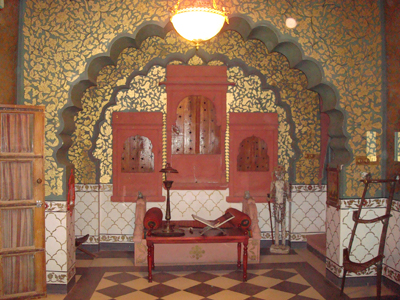 |
| You might
notice certain similarities in these two photos above. The one at left
is the throne room inside the fort's palace where royal dignitaries
would be met. The photo at right is of the hotel lobby where we stayed.
Our hotel was in an old haveli once owned by a local
Maharaja. It was now being run by his grandson who has gone to great
efforts to maintain its integrity. The wallpaper throughout the public
areas is hand painted. The one pictured is painted in gold leaf. |
|


