Dadu Aur Madak
Hampi| As
we approached Hampi the landscape began to change dramatically. Even
though it is just a few miles from Hospet the difference is enough to
be shocking. We had been riding through miles and miles of farm
country, and although it definitely still had a sub tropical feel, it
didn't prepare you for Hampi. The first thing that you see is an
immense boulder field that looks like Joshua Tree, or Cochise's
Stronghold had been dropped down in the middle of Indian jungle. Not
only does the geology change, but it seems to become tropics in earnest. |
|
 |
|
| The
actual village of Hampi sits about 4 kilometers from the area known as
Hampi Bazaar that attracts most of the tourists who plan to stay at the
site. As you leave the village the landscape changes drastically. A
kilometer or so past the spot where this photo is taken, I saw guys
unfolding large, thick, black pads up among the boulders. As it turns
out, Hampi Bazaar had a fair number of guys with these foam pads that a
climber will recognize as "crash-pads". Crash-pads, or landing zones is
what boulderers use to protect them in the event of a fall. For you
gravity hampered individuals, bouldering is kind of a run and gun type
of rock climbing that uses no protection and moves typically more
horizontally along the rock. It is definitely not easier than climbing,
but it has several advantages. The climber needn't carry a ton of gear,
he doesn't even need a rope. It doesn't even require the help of a
partner, although it is always nice to have a spotter. But even though
it could qualify as a world class climbing mecca, climbing is not the
primary draw at Hampi. |
|
 |
|
| The
view above is from Hemakuta Hill, looking northward to Hampi Bazaar and
the Virupaksha Temple. Facing the temple on the right is the main
bazaar road, and beyond the temple just to its right is a twisting maze
of small streets with dozens of small guesthouses. We found an
immaculate place without ac or tv for a third of what we normally pay. |
|
  |
 |
| The
end of the main drag in Hampi Bazaar nearest the temple takes on a
different bazaar vibe as indicated in the photos at left. On top this
man does a very rapid fire open-air infomercial for a plastic device
that braids your hair almost instantly. Although it was all in Hindi,
we found it extremely entertaining. Below, what would the place be
without a few sadhus. In the right hand photo, taken from Hampi Bazaar's opposite end is the real source of the connotation bazaar. The galleries that line both sides of Hampi's wide main street are open fronted shop spaces whose roofs and support columns were hewn from the local rock. These are remnants of Hampi's heyday as a major trading center for cotton, spices, gold, and gemstones. It was the center of one of India's most powerful Hindu empires. If this was all that remained of Hampi it would be impressive enough. But this is just a small portion of Hampi known as the Sacred Center, a tiny fraction of the more than forty square kilometers of development that date back to the 15th to the 17th centuries. Several kilometers away begins a two-plus kilometer section known as the Royal Center. The Royal Center is impressive for its elegance, but sharing the billing in the impressive category for Hampi is the other-worldly landscape and its sheer scope. Over every little hill or horizon you see additional amazing courts and galleries hidden within the very rocks that they were hewn from. |
|
 |
 |
| The
rock for this massive array of complexes was quarried using a simple
method, evidence of which can be found all over. As shown in the photo
at left, you see a line of square chiseled holes in the rock. These
then have wooden blocks hammered into them that are then set on fire.
Before the rock can cool, they then poor cold water into the holes
causing the rock to split. You can see the results in the photo on the
right. The more perfect pieces are used for the elegantly sculpted
columns, and what is left is used for other forms of construction. |
|
 |
|
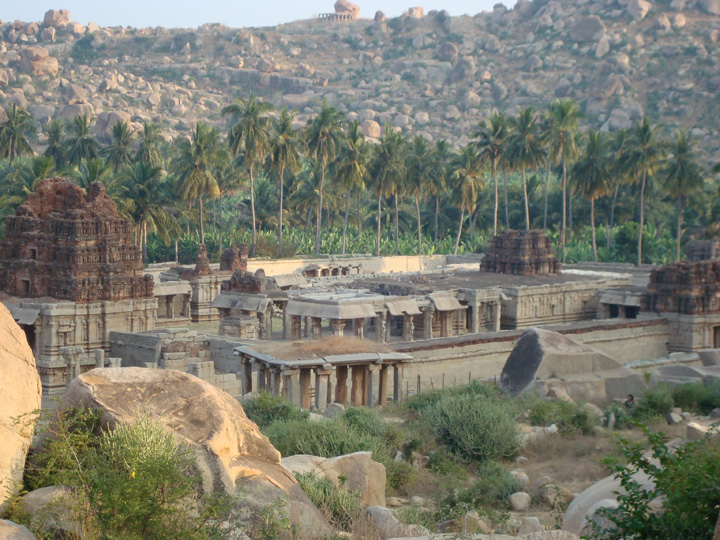
| Every
step reveals vast hidden galleries like the one above, or elaborate
courtyards fringed by palms like the one below. You will note in the
bottom picture (and I am sure several others) the top of the ridge has
a structure at the top just this side of the top. These outposts were
there so sentries could signal the approach of any unexpected visitors. |
|
 |
|
 |
 |
| Whether
it is sheer extent or intricacy, there is something here for all. A
lone visitor marvels at the size of one of the many grand structures
left. While this mass of visitors listen to an explanation of the musical temple right. Properly
known as the Vittala temple, it is called the musical temple because
the smaller pillars carved into the larger pillars they surround are
said to make musical notes when struck, a practice that is vigilantly
discouraged. |
|
 |
 |
| Situated
just below the Vittala temple the ghat shown above left is for
spiritual cleansing. There is another closer to town that locals flock
to in the morning for their regular bathing needs. Close to the
ghats at left there is a convenient place for doing laundry. (right) |
|
 |
|
| As
we have seen elsewhere in India, not all spirituality is expressed the
same way as the orgiastic scene above indicates. You may recall seeing
in one of the images from Khajuraho a man servicing a horse. In the
photo below left the horse reciprocates. Below right, a robust young
woman enjoys the attention of two men. |
|
 |
 |
| Well,
for a place we had not intended to visit, Hampi produced more material
than would fit on this, or many pages. We will have to end for now, and
continue Hampi's Royal Center on another page. |
|


