Dadu Aur Madak
Khajuraho| Another
factor that figured in to our decision to take this slightly longer
route from Varanasi to Agra and break the trip in to several days was
that it gave us the opportunity to visit Khajuraho. I might point out
at this time that I have become such a slacker that I am now more than
three weeks behind with these pages. The fact is that the pages from
Khajuraho to Agra almost never came to be. In Jaipur, our third stop
after Khajuraho, we lost our camera. I normally empty the memory chip
every few days, but I somehow managed to let that get away from me. To
make matters worse, Jaipur was the stop immediately after Agra--the
home of the Taj Mahal. Although we retraced our steps trying to locate
the camera we had no luck. I've never been too big on being in my own
travel photos, but I had promised my daughter-in-law that we would get
a picture of both of us in front of the Taj Mahal for my grandson Evan.
I
spent the next day and a half sunk in a blue funk. Finally, on the
evening before we were to leave, we ran into the same auto-rickshaw
driver that we had used the morning the camera went missing. When I
asked him if he had run across our camera he initially said no. He
acted a little suspicious of us. He said he had seen us go past the
corner where he usually hangs out the evening before, and he asked that
if we had lost the camera why hadn't we stopped and asked him then. We
told him we
didn't stop because we didn't see him and the reason we had gone past
that corner was specifially to look for him. He than told me, "Well
I've got your
camera, I just wanted to make sure it was really yours because I had a
lot of people in my tuk-tuk yesterday." I should point out that these
drivers will take you somewhere half-way across town, then sit and wait
while you have a meal, and then drive you back to your hotel for about
40 to 50 rupees--a sum equal to a dollar or a dollar-and-a-quarter. The
thousand rupees ($25) that I gave our new friend Ali had him smiling
with both of his teeth. I had received a number of concerned warnings
about theft and dishonesty in India, but I simply have not found this
to be the case. I am certain there are crimes of opportunity, and there
is no doubt whatsoever that most people will try to get the upper hand
in negotiations, but I have found Indian people to be remarkably
trustworthy. If your ever in Jaipur and get picked up by an extremely
thin man with just a few front teeth, ask him if his name is Ali--a
thoroughly honest man. At any rate, back to Khajuraho. We had first heard about Khajuraho from Mr. Tiwali back in Delhi on our first few days in India. Mr. Tiwali is the father of Geeta, who along with her husband Alan used to live in our place in Tucson. Her dad is a retired Air Marshal, and a published author. Among his works are essays on the birds of India. He is very well traveled, and he hi-lited more than a dozen places on our maps that he felt we must see. He was especially enthusiastic about what he described as exquisite temples that were in this little town that was not near much else. He said that they were mostly known for their erotic images. I have to say, that in a country where there are temples by the thousands, those at Khajuraho stand out as something not to be missed. |
||||
 |
||||
| Reached
by way of some of the most neglected and some of the worst paved road
we have encountered in India to date, Khajuraho stands in marked
contrast. The first thing that grabs your attention is that the ten
kilometers of side road ( a road you might expect to be less than
perfect ) that leads from the crappy "main" road is an already
excellent road that is being made into a four lane. The grounds of the
main Hindu temple complex is impeccably maintained, as is most of the
spotlessly clean town. Someone has made a very conscious effort to
preserve a valuable cultural asset, something that is unfortunately
grossly neglected in many of India's heritage sights. |
||||
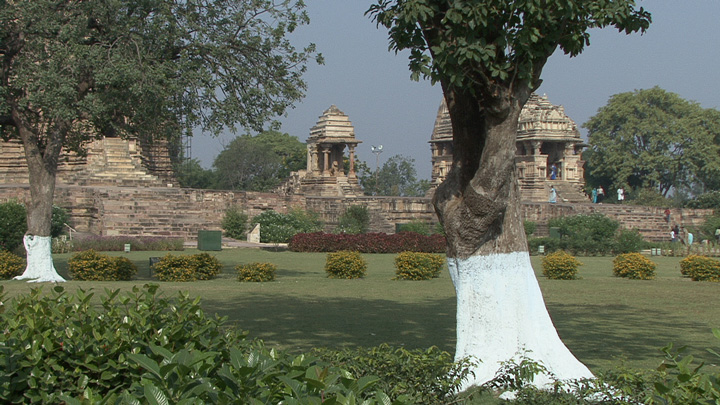
There are two main
groupings of temples in Khajuraho. The eastern grouping is made up of
Jain temples and is less well preserved than the western group depicted
above. The western group of Hindu temples dates to the 11th and early
12th centuries. One of the great puzzles about Khajaruho's temples is
their distance from any population centers. The big question is "Why
here?" It is thought, however, that this very isolation was a factor in
the temples having been spared the devastation that befell many of
India's other temples at the hands of the Muslim invaders. The degree
of preservation is remarkable though, and we noted the fact that there
are not even any pigeons or other birds befouling these as is found at
almost all other temple sites in the country. There are more than a
score of temples and lesser shrines in this one grouping alone.
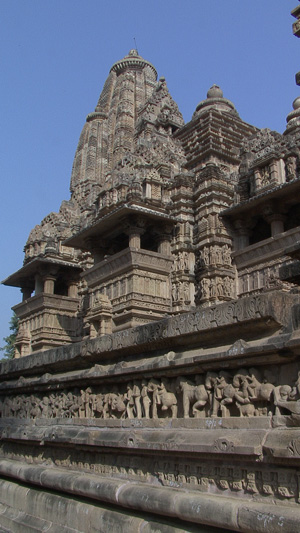
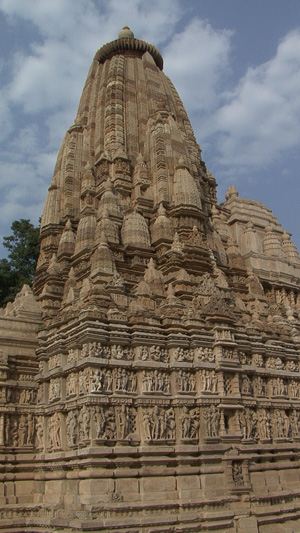
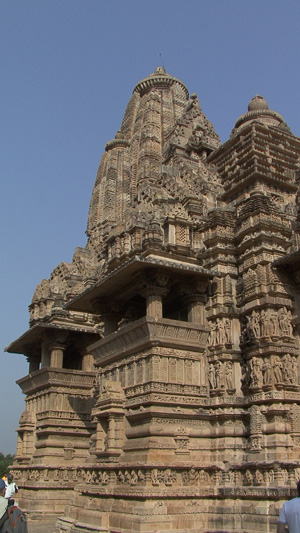
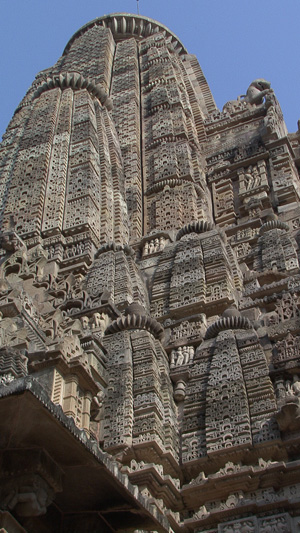
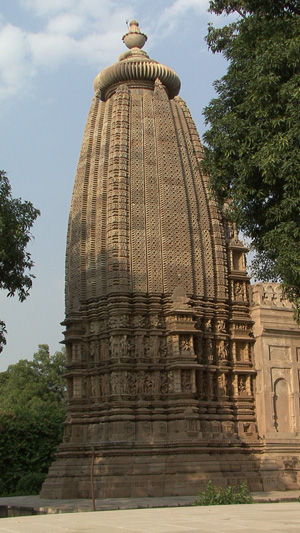
The photo at left above shows some of the detail of the parade of figures that circle the base on which sits the Lakshmana temple. This array is home to some of the most spectacular erotica at Khajuraho. The view at right is from on top of the base platform. The center photo is of Kandariya-Mahadev temple. A tribute to Shiva, its main spire is adorned with scores of smaller replicas of itself. It has nearly 900 figures both human and animal exquisitely carved in relief around its perimeter. |
||||
|
||||
 |
||||
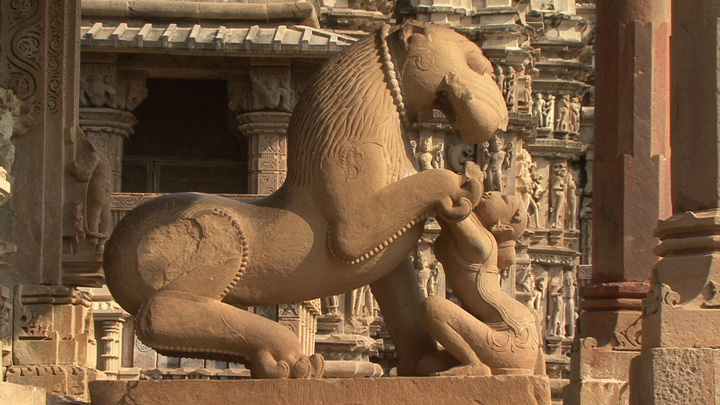
| Many
of the images depict humans interacting with animals or mythical
creatures (a phenomenon even more graphically portrayed on Kajuraho's
erotica page). |
||||
 |
||||
| The
smaller grouping of Jain temples east of town are somewhat less well
preserved, but none the less elaborate. The white temple in the
background is a reproduction constructed only to indicate the scale and
relationships of one temple to another. Some of these reproductions
incorporate the few fragments of the original temples that remain. |
||||
| Khajuraho erotica |
||||