Dadu Aur Madak
Mumbai
| We had heard horror stories about traffic in Mumbai with traffic jams of as much as three hours to get across town. We elected to spend the night in Navi Mumbai across the bay, and slip into Colaba at Mumbai's southern tip first thing in the morning to avoid traffic. We were on the road by 6:30 on a Saturday morning, and as it turned out we found the experience relatively effortless. What did come as a surprise though was the room prices in the tourist center, with very little that we would consider habitable for under a hundred dollars. One of our criteria was finding a place that had an internet connection--an amenity that proved to be of little added value. Internet connections all over town were among the worst we had encountered anywhere in India. A cut cable off the coast, coupled with a concentration of nearly twenty million inhabitants, left internet communication at a virtual standstill. What did excite us though is that Mumbai is home to hundreds of movie theaters many of them showing first run shows in English. This was a particular treat since we hadn't seen a new film in over six months. For someone who saw at least one or two films a week and rented several videos at home, this was like a badly needed fix. We had been hearing a lot of Oscar buzz on TV, and it was all about films we had never even heard of. | |
 |
|
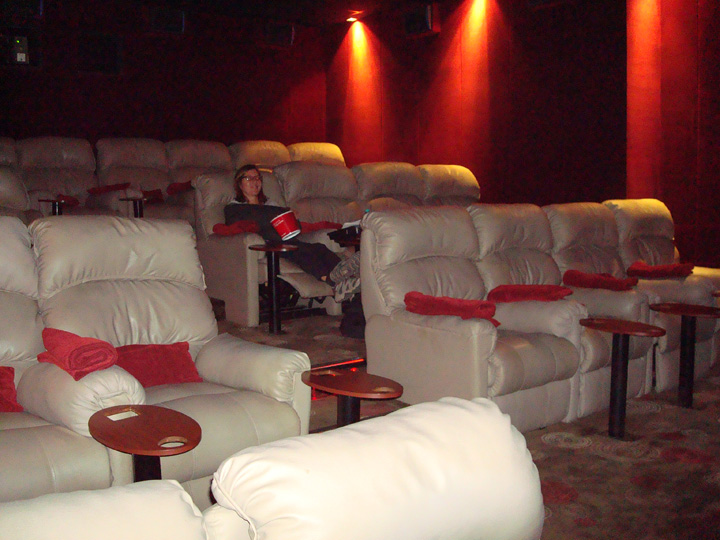
| As
one might expect of one of Asia's most prolific film cities, cinemas
can
be quite luxurious including comfortable recliners complete with
blankets and pillows with waiters that come to take your order. They
even serve cocktails, and ticket prices for the luxury salon are about
$8 to $10 dollars US. Seating in the regular theaters are around three
to six dollars, and all are reserved seating. Since we would be waiting
around for Lalli's man to show up we took the opportunity to catch up
on some of the Oscar contenders. |
|
 |
|
| Mumbai
is a city of vast contrasts in wealth. One of the premiere symbols of
wealth and luxury in India are the Taj group of Hotels. Their flagship
hotel (above) in the Colaba district of Mumbai was built by the scion
of the wealthy industrialist Tata family after being denied admittance
to a European hotel because he was a "native". The Tata name is now as
ubiquitous in India as curry, and is found on everything from car and
truck manufacture, to retail automotive dealerships, to hotels, to
telecommunications, to retail diamond jewelry, to schools of business
management training, and the list goes on. |
|
 |
 |
| The Taj Mumbai
looks out on one of Mumbai's most famous landmarks, the Gateway to
India (left). Like many of India's landmarks it is sheathed in
scaffolding. It seems that much of the renovation work here reaches
that stage and doesn't get much farther. The plaza in front of the
Gateway is host to a unique gathering each morning at sunrise when a
local man leads a group in "laughing yoga." The group is put through
its paces doing everything from giggles, to belly laughs, to guffaws.
Locals and tourists alike join in, and everyone seems to love it.
Meanwhile, at right some of the men doing repairs and renovations on
the Gateway and plaza enjoy an early morning shower from a water tanker
on hand. |
|
 |
|
| In
contrast to the relative luxury found in the neighborhoods near
Mumbai's southern tip the dhobi ghats in the central city offer a
different perspective. Here on acres of land adjacent to one of the
city's rail stations some 5,000 dhobis (laundry men) hand wash a fair
portion of Mumbai's laundry. |
|
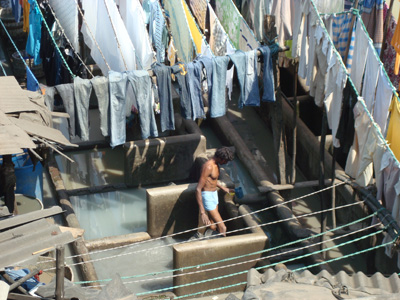 Water is channeled into concrete troughs and even feet get into the act here. How laundry is kept straight as to what belongs to whom is a mystery, but somehow it is. Part of the organization is accomplished by sewing in a single colored thread to each individuals batch of laundry. When you see the scope of this it still seems remarkable, and it appears to border on chaos. |
 |
 |
|
| The
Victorian architecture of Mumbai's south end is unlike anything else in
India. Below is the South Central Rail Terminus, also known as Victoria
Station. |
|
 |
|
 |
|
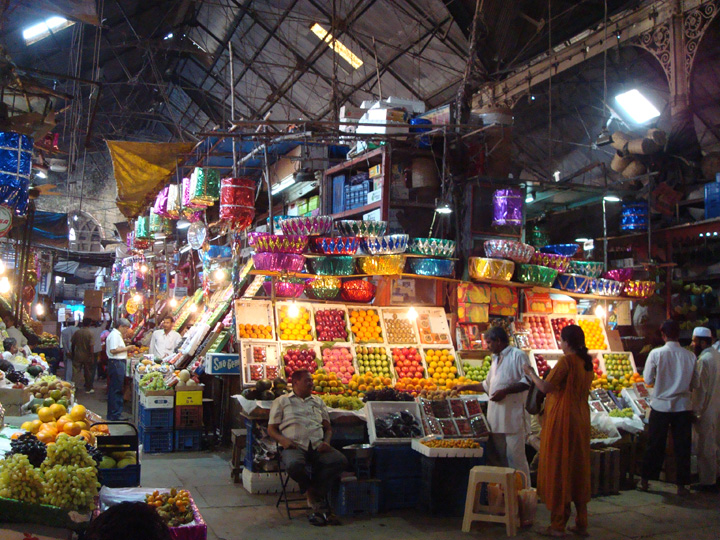
| Also
near the Victoria Station are the colorful Crawford Market (above)
where one can buy everything from fresh produce to birds and puppies,
and Dalal street (below) home to India's stock market. |
|
 |
 |
| The
Dalal Street Stock Exchange has a replica of the Wall Street Bull,
while outside Sunday morning finds the area abandoned except for an
impromptu cricket game. In fact on Sunday everyone seems to be playing
or watching cricket in one form or another. |
|
 |
 |
 |
|
| Above
left, Sunday morning finds these men crowded around a TV set shielded
from the sun by a cardboard box to watch a professional match.
Electricity is appropriated from a building's corridor. At top right is
one of a dozen or so games being played on Mumbai's Oval Maidan on any
given Sunday. Some of the games have regular officials (bottom), and
are played with a heightened level of intensity. |
|
 |
 |
| For
those who are not sports fans, Mumbai has some of India's most
manicured and best kept parks (above left), or one can just wait for
the sunset at Mumbai's Chowpatti Beach (above left). |
|
 |
 |
| While
we were there, Mumbai was host to a week long arts festival scattered
with a variety of venues and mediums like this different take on the
ferris wheel (left), part of group of installations on a small lane
near our hotel. Or you could head for "fashion" street (used in the
loosest interpretation of the word), where more than a mile of small
demountable stalls are set up each day to sell everyday clothing at
cheap prices, |
|
 |
|
| Finally
after five days Imran and his associate showed up to buy back the bikes
and we had to bid a bittersweet farewell to the Enfields. |
|
 |
|
| We
had a 5 am flight for Bangkok so we had to be at the airport by 2 am to
clear customs and security. One of the constants throughout our six
months in India, were the almost daily television or newspaper stories
about Shah Rukh Khan, or SRK as he is also referred to. He is India's
most famous actor, and looks a bit like Mick Jagger and is often
pictured with open shirt or shirtless to display his trademark ripped
abs. His current Bollywood hit was a musical (most of them are) called
Om Shanti Om, and the title song could be heard blaring from cheap
speakers in shops and markets all over India. While we were questioning
why our one extra piece of luggage was going to cost $250, nearly the
price of a ticket, Karen spotted him standing with his bodyguard right
behind the ticket agent. By the time I got my camera out I was able to
capture this stunning candid portrait of the back of his head. |
|

