Dadu Aur Madak
Bhuj and the Kachchh| Our
initial intention was to bypass the State of Gujarat, but we had met a
couple from New Zealand that operated Enfield tours at our hotel in
Udaipur who said that it was really quite beautiful. Gujarat is another
of India's westernmost states that borders Pakistan. Our first evening
we laid over in Ahmedabad, Gujarat's capital to top up our Rupees. The
first thing that is evident is the vast divide in wealth. Gujarat is a
relatively prosperous state from farming and ship building among other
things. While Ahmedabad had a thriving University area with upscale
shops and wide expanses of green space, it also had river front hovels
right below pricey upmarket hotels. We later were approached by an
American of Indian descent from Boston while we were in Bhuj. He was
about 35, and recognized us as Americans. His accent was completely
American, and he said he had not been back to India in more than ten
years. Karen asked him what he found the most changed. His answer was
that "...the haves have gotten hav-ier, and the have-nots have not-ier." |
|
 |
|
| I
was able to get this quick snap at one of India's rare traffic lights
in Ahmedabad. It's a family of six on a Vespa size scooter. In the
background you can see an individual on the same size vehicle to give
you an idea of scale. |
|
 |
 |
| Bhuj
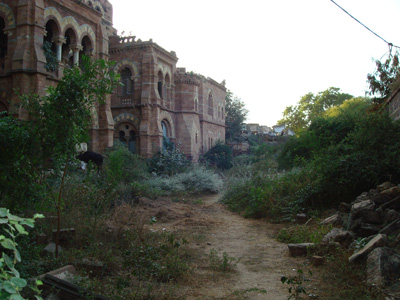
is located in a area of Gujarat known as the Kachchh, alternately
spelled Kutch (rhymes with Dutch). In 2001 it was the epicenter of an
earthquake that devastated the town, killing more than 15,000, and
leaving countless thousands more of its population of 150,000 homeless.
The signs remain everywhere still, and many chose to leave, yet there
are also signs everywhere of rebuilding (below), a tribute to the
indomitable spirit of these people. |
|
 |
 |
 |
 |
| The
damage extended to two of Bhuj's most popular tourist attractions, the
Prag Mahal left, and the Aina Mahal right. While the Prag is unsafe to
enter, there is a small portion of the Aina Mahal that remains open. It
is reduced to a few rooms, but the magnificence of this Palace remains
evident. The curator here arranged for a car and driver to take us up
into several villages near the Great Rann of Kachchh. The most obvious
thing about Bhuj, though, is the rarity of tourists here. It is home to
some of the most friendly people we have met anywhere. There is never
an initial request from a tuk-tuk driver for ten times the value of a
fare, the price you are quoted is the actual price. But more
importantly, everywhere we went people said hello to us. They asked our
names and where we were from, and it was not the typical "...come visit
my shop." People even shouted hellos from passing vehicles. It was
really refreshing, and although we had planned to stay a day or two, we
ended up staying for five days. |
|
 |
 |
| Bhuj
sits on a lake surrounded by ghats. Along its edges are some of the
temples beautifully restored following the quake. |
|
 |
|
| We had to get
Police permission (a relatively simple process) to visit several of the
villages near the Great Rann of Kachchh. This shot is from the hilltop
village of Kalo Dungar a little over a mile from what looks like the
"sea's" edge. This is as close as foreigners are
allowed to get. It is not because of danger to the fragile ecosystem,
but rather it has to do with the fact that the border with Pakistan is
only seven
miles away. What looks like a frozen lake stretching to the horizon is
a actually a table-top flat piece of salinated land. It is low lying
land that fills with water during the monsoon season until it mixes
with sea water. After the monsoon it dries, as it is here in this
photo, and becomes as hard as
rock. On the way to Bhuj we did get to cross the Little Rann of
Kachchh (below) where tribesmen divide portions near the roadway into
these small catchments where they can harvest the salt. The Little Rann
seperates Gujarat into its to main parts, the Kutch, and the lower
peninsula known as Saurashtra. |
|
 |
|
 |
 |
| The
Kutch itself is a spare but beautiful landscape, but its real beauty is
in its people. |
|
 |
 |
| This mother son
team of potters welcomed us to their home in the village of Khavda,
another of the villages we needed police permission to visit. He hand
shapes clay bells while she paints designs on cups,
rotating them by hand on a small wheel. Fired in a low temperature
kiln, they make simple but beautiful pottery (below). |
|
 |
|
 |
|
| But
it is not just those with something to sell that make you feel welcome
in these tiny villages. Here this very talkative woman approached
Karen, and then gradually her husband also drew near. |
|
 |
|
| In
another village you see the Kutch's real wealth above, while below you
find homes ornately decorated inside and out, and women laying out
their exquisite needle work for the tourists they hope will come. |
|
 |
 |
 |
|
| Here
a Harijan woman shows Karen her wares inside her home. Every inch of
the walls are decorated. These people not only make these wares but it
is part of their everyday garb. The Kutch is home also to some very
simple white-clad farmers, who do quite well raising vegetables and
cotton. They are seen frequently in Bhuj's numerous gold shops
purchasing ornaments for themselves and their wives. |
|
 |
|
 |
|
| On our last day
we visited Kala Raksha, a collective of women artisans in the village
of Samrasar. Started by an American woman who has devoted more than
thirty years to assist local women in self-improvement and to promote
their art, it attempts to take some of the profits that normally go to
middleman shopkeepers, and put it back into the hands of the women who
actually do the work. They produce designs on items that are more
sought after by tourists, and the workmanship is of museum quality. The
two young ladies at left, Garima and Tanushree, are interns from a
University in Baroda who
were spending some months assisting at the collective. The girl at
right, Shikha, is a friend of theirs from school. Herself an intern in
a project elsewhere, she was here visiting her
friends for the weekend. They hitched a ride with us into Bhuj for some
R & R. |
|


