Dadu Aur Madak
Jodhpur| Jodhpur
is the last in the triumvirate of Rajasthan's colored cities. Known as
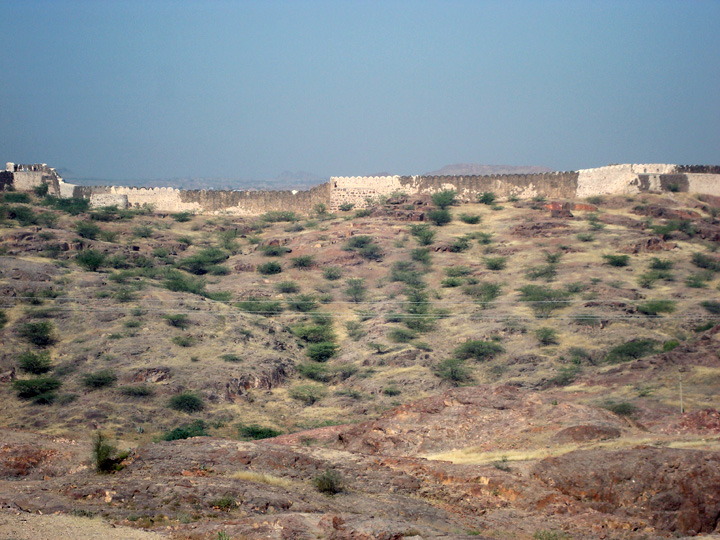
the "Blue City", Jodhpurs old city sits within a wall of more than six
miles in circumference. As you approach the town you can
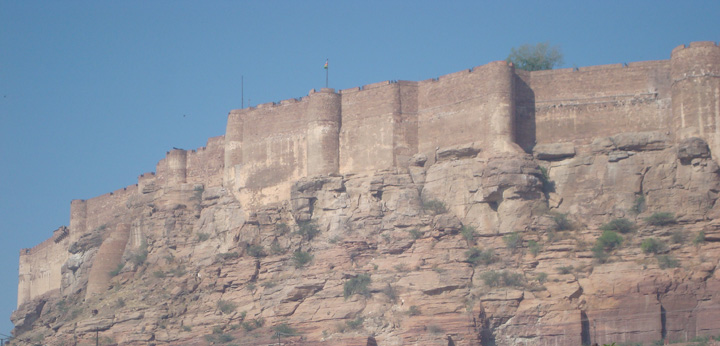
see from some distance Jodhpur's dominant feature, a
massive fort that fills the top of a rocky promontory more than
four hundred feet high. It is not only its spectacular setting though,
but also the sheer mass of the structure. The fort's walls are
enormous, and the palace that it houses rises even above those walls.
We had decided to make Jodhpur a rest day from trudging through the
typical tourist drill especially after having viewed countless forts in
other towns. After a while one is left wondering about the psyche of
the Indian people. They are devoutly religious, and prayer and
offerings are part of their daily routine. Yet everywhere you look
there is evidence of their warlike history. Almost all towns of any
size have their own fort. Even the epic poems that so gracefully
describe India's history and the pantheon of gods and goddesses they
worship are rife with stories of great battles. Having once been a
loose conglomeration of princely states, the multitude of forts were
far more than a mere show of power. Indeed all of them defended their
respective subjects from battles over profitable trade routes and
religious conflicts alike. This is no small cause for concern in a
country with nuclear weapons where there is armed violence or bombings
in one corner of the country or another almost on a daily basis. Much
of this violence is between rival political factions, but a fair
portion of it is still religious in nature. There is always blame laid
on one group or another, but seldom have we heard of any resolution.
Like the absence of traffic enforcement there seems to be little in the
way of prosecution in localized violence. In just one week near the
beginning of our trip we heard of two separate incidents in the state
of Bihar where angry mobs had beat to death a total of thirteen people
suspected of burglarizing homes. The thought of the United States
entering into a nuclear pact with India is more than a little
frightening. All of that being said, everything we heard about the
fort, along with its sheer magnitude conspired to draw us in. As it
turns out it was one of the most impressive forts we have seen, with
one of the most fairly priced admission packages to date. The cost of
admission includes camera charges, and provides the visitor with a very
thorough and impressively informative audio tour in several languages.
It's run by the maharaja of Jodhpur and it is also meticulously
maintained. |
|
 |
|
| Jodhpurs
six plus miles of wall, as seen here from the fort are impressive in
their own right. They are fitted with eight gates allowing entry to the
old city. |
|
 |
|
| The
fort itself on its lofty perch is visible for miles. Inside the town it
can be seen virtually from everywhere. |
|
 |
|
| The
ramparts above are of an impressive size, but the closer you get the
more the massive scale becomes apparent. (below) |
|
 |
|
 |
|
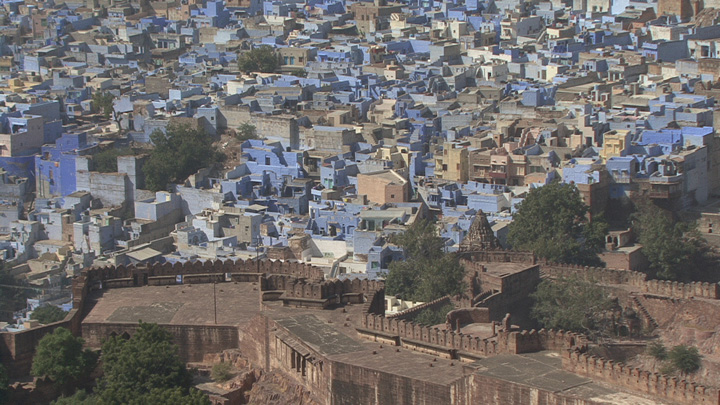
| Viewed from the
top most floors of the palace within the fort Jodhpur lives up to its
name "the Blue City." |
|
  |
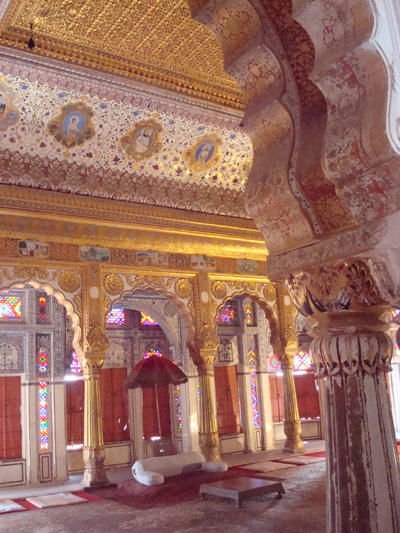 |
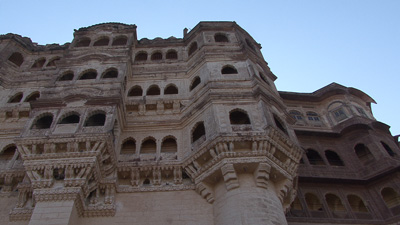
| The palace is a
multi-storied structure (top left) that now serves as a museum. The
guided audio tour is a welcome tool with its numbered stations helping
to find one's way through the scores of rooms. The throne room at right
was for receiving visiting dignitaries. The gold and precious stone
inlays are stunning. The gentleman at lower left peers out of a window
in one of the women's quarters. The window would have been covered by a
finely slatted bamboo shade that had been soaked in water scented with
flowers and exotic spices or incense. Wind blowing through the damp
shade would both sweeten and cool the desert air. Both the shade, and
the intricately carved ornate sandstone screens are in keeping with the
tradition of purdah, the
keeping of women in seclusion or veiled. |
|
 |
 |
 |
 |
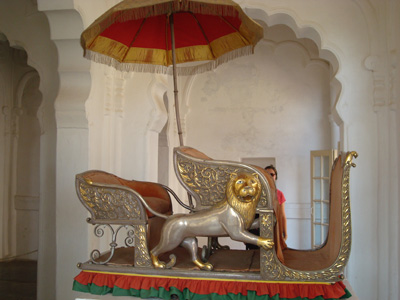
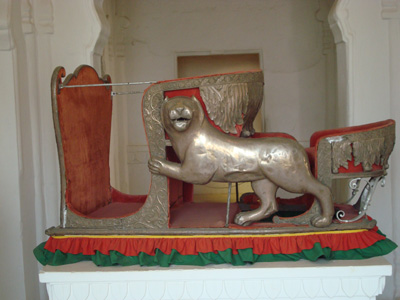
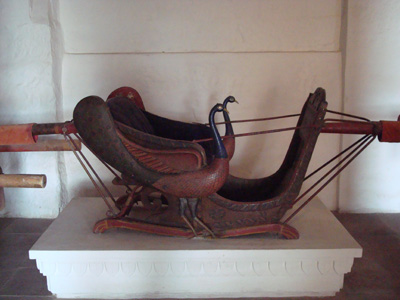
| Beside the
extensive collection of military armaments and edged weapons, the
museum housed all manners of royal artifacts from items of every day
use, to priceless ceremonial items. One of the more interesting
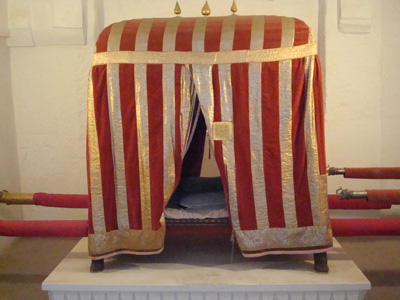
collections was an extensive array of lavish howdahs, some of them clad in gold
and silver. Howdahs are seats built to carry passengers on elephants.
The one at lower left would have been for a woman, also keeping with
the tradition of purdah. |
|
| Unfortunately
we did experience one slight incident of unpleasantness in Jodhpur.
Many of the guide books warn lone women travelers about unwanted
attention from men in India. In some areas this proviso is reiterated
in stronger wording. We had witnessed young men dogging women on the
waterfront of Lake Dal in Kashmir. While this was mostly a nuisance it
was seldom vulgar. We did hear of at least one incident involving a
hotel owner that had left the young woman feeling a little more
threatened. Karen and I had just finished eating lunch in a nice little
vegetarian restaurant near Jodhpur's train station. I was in need of a
pair of reading glasses, and Karen had some work to do on the internet.
The helpful waiter directed me to a place about a block north for the
glasses, and Karen to an internet cafe near the train station one block
south. While I was still in the optometrist Karen came in saying she
had found the internet place closed. As we left she told me "...well I
got my first 'come fuck me babe'". I asked her what she was talking
about and she said on her way to the internet place a young guy on the
corner had made the remark to her, but she just walked on and ignored
him. But after finding the internet place closed she had to return the
same way and he repeated the remark. At this point she turned and
glared at him, and he looked away acting as if he hadn't said anything.
I felt that this was something that warranted something a little stronger than a dirty look. Especially in light of the way Indian culture insists on sheltering their own women from view whether they like it or not. The most provoking point is that the guy was in his mid twenties and Karen is almost old enough to be his mother. The idea of saying something like that to a married Indian woman is unthinkable. When we got back to the corner I asked Karen to point him out. The corner had several outside food stalls with mostly older men sitting at outdoor tables. The offender was working at one of the stalls standing behind a chest high counter and stirring a large pot with a mixed vegetable masala. I asked him if he had made the remark to my wife, but he didn't respond or even make eye contact with me, so I repeated the question a little louder, and then inquired if he wouldn't prefer me to perform the aforementioned service on him. Still there was no response or recognition so I made some speculation about his relationship with his mother. The twenty or so men in the establishments on either side just looked on kind of surprised. I don't know if they were just unaccustomed to seeing a foreigner being confrontational or they had never seen veins bulging in someone's neck. The counter top had two large metal bowls of produce on it. One was a bowl full of small heads of cauliflower with the leaves still on it. I was finding his unresponsiveness a bit irritating, so I rather unceremoniously added the cauliflower to the dish he was preparing along with the metal bowl. That finally aroused eye contact, and I then offered him one more opportunity to contribute something to the conversation. At this point one of the older men dressed all in white with a large mustache of the same color walked over and with a sincerely apologetic look gestured with his head toward the street and said simply "please sir." I think that these guys felt that the kid had it coming, and nobody showed any disapproval of my chastising him, but they just wanted to see that it didn't escalate, and were actually quite polite and sympathetic. The important thing is that these young guys think they are doing something cute, and I just wanted to make it clear that it was unacceptable. |
|


