Dadu Aur Madak
Udaipur| The
map we had showed that after traveling the first hundred kilometers or
so south from Jodhpur the next hundred kilometer segment that headed
east to Udaipur was multi-lane divided highway. As it turned out, the
southbound section from Jodhpur to Sirohi was the most heavily
trafficked road we had encountered in all of our time in Rajasthan. It
was a two lane blacktop that alternated between barely adequate to life
threatening. Even though we were traveling early as usual and that it
was a Sunday morning, we still spent most of that route dodging
oncoming trucks that were in our lane passing. Passing in India is
something that is done without any regard whatsoever to traffic coming
from the opposite direction. Regardless of the degree of stupidity of
any given maneuver, a good rule of thumb is that the right-of-way goes
to the largest vehicle. This explains the inordinate amount of
multi-truck or truck bus accidents. It also accounts for an equally
ridiculous number of single vehicle accidents caused when vehicles
swerve to avoid the death defying passer. You can be approaching at 80
kilometers an hour and will have passed the oncoming vehicles in 6
seconds, yet a truck doing 40 miles an hour will not wait for you to
pass, but rather will pull out to pass another truck doing
thirty-eight. The whole operation will take something like four
minutes, and you will be meanwhile forced to go on to the shoulder to
avoid being obliterated. Even worse is the truck that's pulling out to
go around a farm tractor while at the same time an SUV is going out
further still to pass the truck--all of this on a narrow two-lane with
no shoulder. Well when we reached the portion heading east we found
that it in fact was not a four-lane as the map had indicated, but the
first twenty miles was actually a single lane with traffic traveling in
both directions. After that first twenty miles we did in fact encounter
the four-lane and a mile or so of it every 4 or 5 miles was actually
paved, although it was generally only on one side. Equally frequently
you would be diverted off of the four lanes of hard packed dirt on to a
one or two lane bypass. That hundred miles was dusty, bumpy and slow.
To the credit of India's road builders though, in the course of that
100 miles we saw more than 20 people working on some half dozen
scattered stretches. On top of that we saw at least three pieces of
heavy equipment, to say nothing of the half dozen or so dump trucks.
When we finally found a place to stop for petrol about 40 kilometers
out of Udaipur we asked if the road got any better on the way into town
but we were told it was a work in progress. |
||||
 |
||||
| The
only thing making the driving along this stretch tolerable was the
colorful encampments of desert people with their herds that we
encountered on the outskirts of every little town and water hole that
we passed. Most were headed for Pushkar to take part in the massive
camel fair there. |
||||
| In
a bizarre twist, after having traversed probably the worst roads we had
found in Rajasthan, as we entered the town we were rounding a curve and
Karen skidded out on some soapy drain water that was running out
directly on to the roadway. She had the wind knocked out of her, and
had went down pretty hard on her elbow. Her padded jacket kept it
from being any worse. We were kind of able to milk her misfortune to
our advantage though. We had arrived one week before Diwali, a
celebration that is dragged out for as much as two weeks. Udaipur,
which is widely known as a honeymoon or simply a romantic destination
is one of the places that the guide books advise you to avoid even
trying during Diwali and the two weeks following. We found a hotel that
actually had a vacancy, and the helpful manager even directed us to a
hospital called the GBH American Hospital. It was a far cry from the
state hospital I had visited in Himachal Pradesh. It was a private
hospital that had every modern convenience, still our bill for two
x-rays a doctors consultation (who had to be called to come in
from home), and the prescriptions that he had written cost under twelve
dollars. We told the hotel owner that the doctor had told her she had
to stay off the bike for at least a week (a slight exaggeration), and
he
was more than happy to accommodate us. |
||||
 |
||||
| Udaipur
is a fair sized city, but the majority of the tourist activity is
centered around the lake. Along the waters edge there are more than a
score of several story hotels boasting rooftop restaurants. Of course
like most lakes in Indian cities, the shoreline is ringed with ghats.
Udaipur's real claim to fame though is The Lake Palace Hotel pictured
above that takes up every inch of Jagniwas Island. It was one of
several sites around Udaipur that were used in the James Bond film Octopussy. Literally all of the
the rooftop restaurants in town advertise that the film is shown
nightly, usually with a second feature. |
||||
 |
 |
|||
|
Also in
the lake is Jagmandir Island which is host to a palace built by two
successive Maharajas in the early 17th century. On the far side of the
lake (right), is a new upscale hotel Udaivilas with prices ranging from
$450 USD to two grand for a suite with private pool.
|
||||
 |
||||
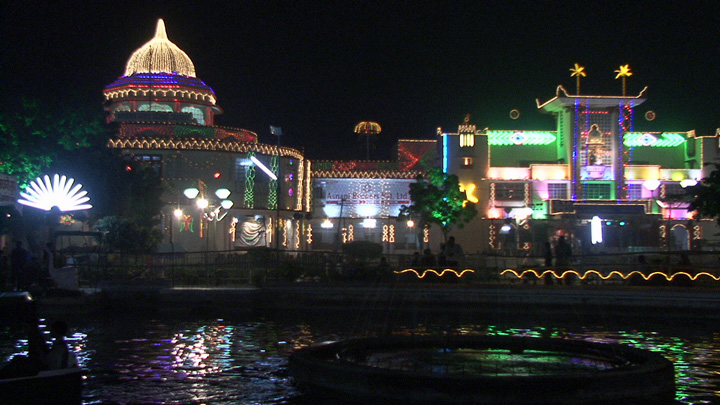
| In the week leading up to Diwali, the town busied itself stringing lights and cleaning up the city. Diwali celebrates the Hindu new year and is known as the festival of lights. Udaipur's old section has open channels covered with concrete slabs for sewers, and these were cleaned of all debris and hauled away. The largest part of the celebration takes place in the old city. This night shot taken from across a narrows of the lake shows the lit up ghats and part of the City Palace. | ||||
 |
 |
|||
|
The City Palace was
outrageously expensive to visit and the shot at left is the closest
they will let you get without paying. The shot at right was taken with
a telephoto from a hilltop called sunset point.
|
||||
 |
||||
| Udaipur is home
to scores of temples and one of the more impressive ones is the Jagdish
temple near the center of the old city, but the attendance her is
dwarfed by that at he tiny Laxmi temple down one of the small lanes in
the old city. Laxmi is the goddess of wealth, and so many people come
to visit that they have to bore holes in the pavement to put up pipe
and rope barriers to keep the procession orderly. Like many temples in
India, men and women have to enter from different doors. |
||||
 |
 |
|||
| As
Diwali approaches the Laxmi temple becomes the center of activity, with
men and women seperated. In the last few days all becomes lit up.
Diwali is the festival of light and celebrates the Hindu New year. Watch the video. |
||||
 |
 |
|||
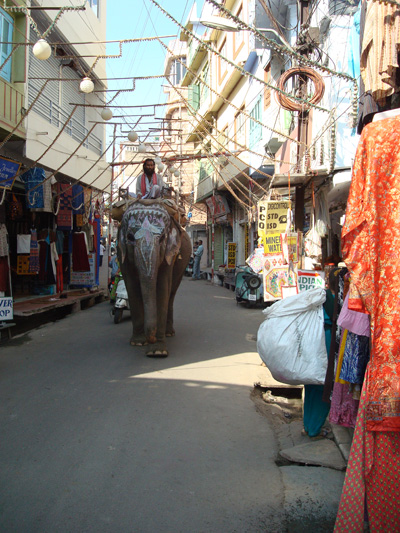
| Even the
animals get decorated (left), and it is a very auspicious time for
weddings. I had to get the permission of the groom to photograph this
young bride at right. The stripe of vermilion down the part of the hair
indicates that this woman is married and off limits. |
||||
 |
||||
 |
||||
| Not
to be outdone, the downtown of the new city is also lavishly lit. The
top picture is of the Town Hall. In the bottom shot the lights even
extend to crystal chandeliers. Just as a side note, I have to include
this video. Karen found it so amazing she talked about it for days. At
the Town Hall there was also a sizable carnival. We paid to see this
event that took place in a wooden tank about 100 feet high and 100 feet
in diameter. It is called the "Well of Death". The video quality is not
that great because it was pretty dark, but what you are looking at is
three motorcycles and three cars driving around the interior of the
tank at the same time. More impressive is the fact that the cyclists
wear no helmets and drive with no hands, while the car drivers open
the top side door and lean out of the car and wave. It's wacky. Check it out. |
||||
|
||||
 |
 |
|||
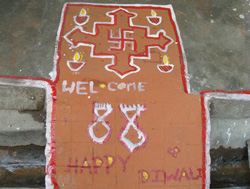
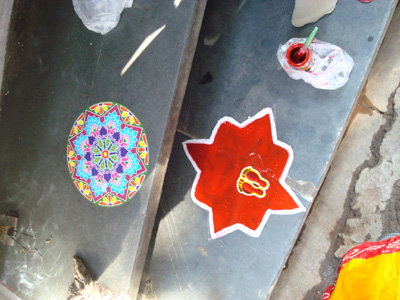
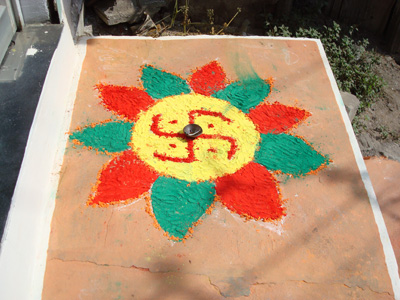
| Besides the
lights, the old city is decorated on every stoop, from the most humble
to the elaborate. The colors red and white are considered the colors of
good fortune. We asked the kids around the stoop at top right what the
footprints signified. They said it was so Laxmi could find her way
there. I asked him if Laxmi had two right feet, at which point they
called out the guy who had done the painting and had some fun with him.
A few days later we were walking to breakfast when someone started
chasing us down the street. It was the artist just wanting to show us
that he had corrected the feet. The design at bottom right is made with
the powders of ground up stone. |
||||
  |
 |
|||
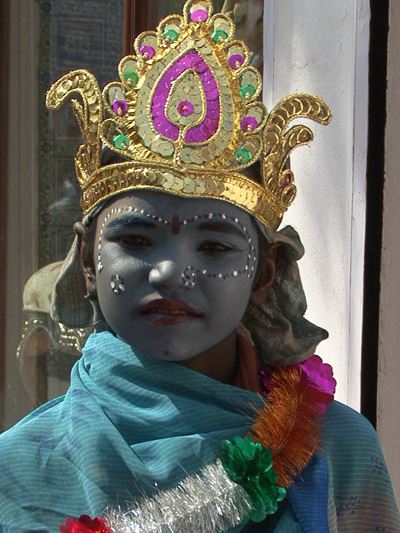
| On
the morning of Diwali the throng around the tiny Laxmi temple becomes
even more intense. Almost all pilgrims bring in garlands or handfuls of
flowers, and these women are busy all morning. This young lady has come
dressed as the blue goddess. |
||||
 |
||||
| Even
royalty gets in on the act. The throng parts as the Maharaja of Udaipur
and his young Maharani make their appearance. |
||||
 |
||||
| An
honor guard precedes him clearing a path. |
||||
 |
||||
| His 20s era
Rolls Royce was as long as a locomotive with headlights the size of
garbage can lids. |
||||