Dadu Aur Madak
Nainital| Our
friend Lalli had recommended that if we had a chance on our way to
Nepal that we should visit a friend of his in Almora. Almora is in the
heart of an area that is rich with hill stations. Hill stations were
towns developed by the British because of their cooler climates as a
place to escape the summer heat. Almora goes back though much farther
than that as it was developed by the Chand Rajas as a summer capitol in
the 16th century. We knew that Almora hosted a major Nanda Devi
festival in September, but we didn't know the date. When we reached
Ranikhet, the turn-off for Almora we encountered about 100 tourist
taxis that were waiting there at the railhead. It was September 20th,
and it turned out that this was the day the 5 day festival begins. We
were told that the chances of finding a room were nonexistent. Once
again the road determined our itinerary. |
|
 |
|
| Tourism
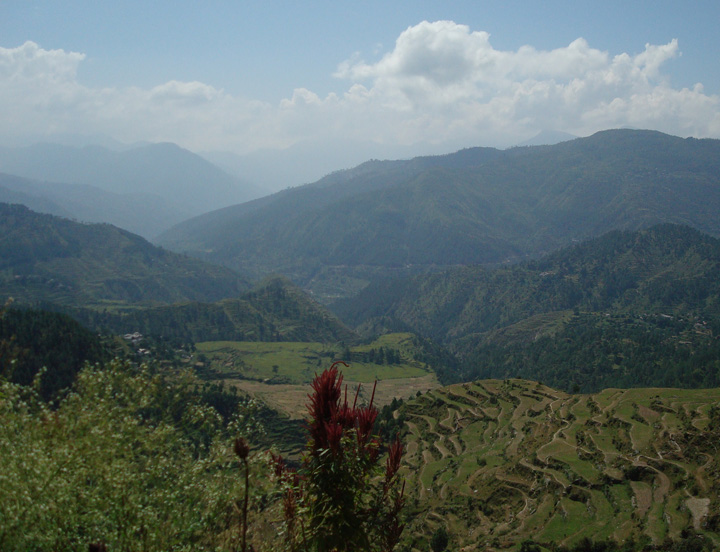
has made the hill station towns of Uttaranchal and Uttar Pradesh quite
prosperous and the roads around Ranikhet and Nainital reflect that,
they are the best we have encountered in all of India. That changes
dramatically once you reach the plains. |
|
 |
|
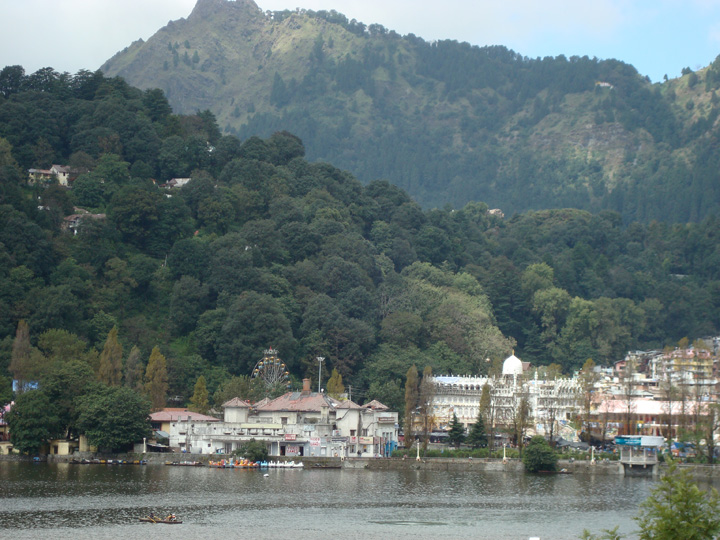
| Nainital
sits on the shore of Lake Naini, said to be one of the green eyes of
one of Shiva's wives. Above is the view from our hotel suite. it was a
beautifully furnished place and deeply discounted because, although the
town has its own Nanda Devi festival it loses business to the much
larger one at Almora. This small strip of lakefront is home to a
Buddhist temple, a Jain temple, and a Muslim mosque. |
|
 |
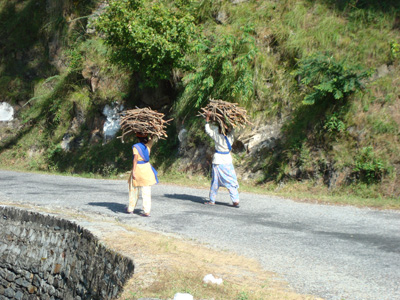 |
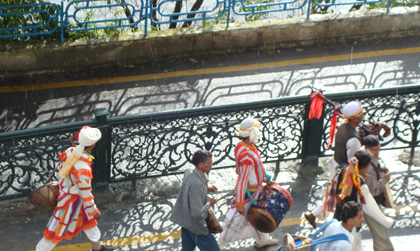
| A
light rain didn't curtail the constant parade of celebrants below our
hotel window. This group at left was one of several that featured a
bagpiper. At right women in their traditional dress still went about
their daily chores. |
|
 |
|
| Across
the lake you can see one of the palatial structures that are remnants
of the British era. |
|


