Dadu Aur Madak
Pushkar|
We headed out from Jaipur
for Pushkar by way of Ajmer. It is a short day of riding and the first
105 kilometers of road was six lane highway all of which were actually
in use. It was hard to believe, and we kept waiting for it to turn into
one lane of sand as we had seen happen before. It was unquestionably
the best road we had encountered in all of India. We found ourselves
wondering why it was there. There isn't much along this stretch, but
for the first 75 kilometers or so we kept seeing billboards advertising
developments of coming lots, homes, villas and the like from a dozen or
more developers. Surely they know something that we don't know.
Kishanghar, the town where the six lane ends is a bustling place
though, and Jaipur with over two million residents is Rajasthan's
capital. Kishanghar is a center of the marble quarrying industry, and
this end of the six lane is marked by an endless stream of billboards
advertising for marble wholesalers and products. The entire length of
the town is lined with dealers selling white marble slabs and raw
blocks as well as shops selling marble furniture, fountains, lawn
ornaments, and anything that you could think of that could be made out
of stone. Of course the six lane as it entered the town went down to
two with parked trucks making it effectively about one and a quarter.
What roadway that was left was being plied in both directions by
ancient trucks grossly overloaded with immense blocks of marble. They
of course were traveling at 4 miles an hour except for the ones that
were attempting to pass who were doing a breakneck four and a half. I
constantly find myself wondering how a culture that has given the world
structures like the Taj Mahal and forts of such monumental proportions
can't seem to string together one hundred miles of continuously good
road, and why the few miles of good road that they do have don't seem
to be subject to any kind of traffic laws that I can see
being enforced. The extent of traffic enforcement that I have witnessed
is the occasional foot cop beating on the hood of a tuk-tuk that has
tried to venture into a pedestrian mall where they are prohibited with
the meter long cane that they all carry. It seldom amounts to more than
a few heated words and then both go about their business. Occasionally
you will see a half dozen or so policemen standing around an overturned
truck that is lying on top of an SUV all scratching there heads and
just looking on. There is certainly no effort on their part to
contribute to an orderly management of the mile long backups on either
side.
At any rate, we are here to talk about Pushkar. This is two pages of ranting in a row for those of you keeping score. Pushkar was one of the first destinations on my "must see" list. Pushkar is home to an enormous camel fair each fall. Like many festivals the timing is determined by some cycle of the moon in one or the other months of the Hindu calendar. Initially this sounded to me like a great event to photograph. Pushkar is described as a quiet little pilgrimage site that swells significantly for this event which leads up to a religious gathering on the full moon. The more we heard about this event the less appealing it sounded to actually be there when it got started. This town of under twenty thousand draws nearly 200,000 visitors and another 50,000 head of cattle and camels. Even if you did have a place to stay during this mayhem, local resources, which are less then optimal, must be strained beyond comprehension. We hit town around three weeks before the fair having decided that we would only stay for a couple of days. We ended up staying for nearly a week. |
|
 |
|
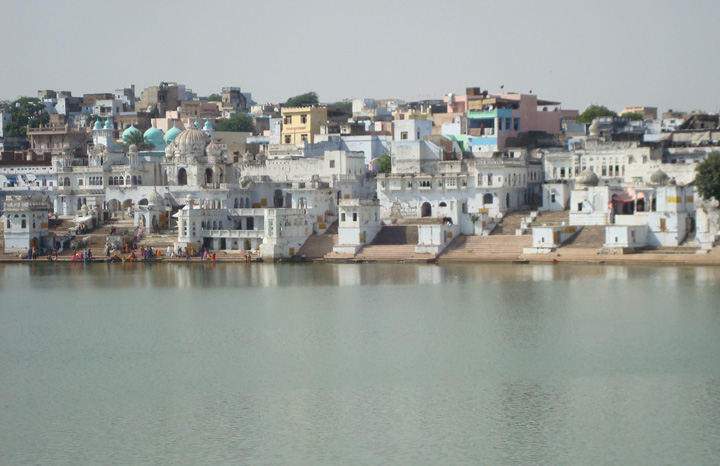
| The
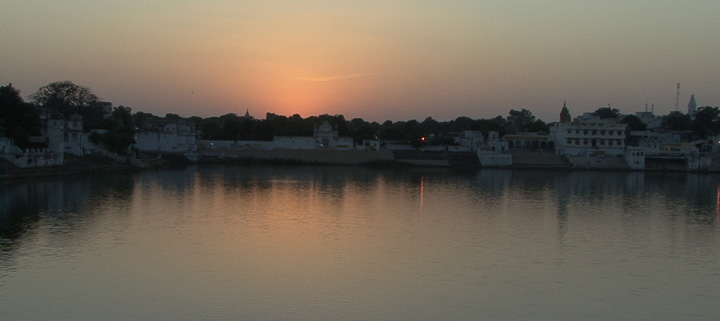
town itself wraps around a tiny lake of the same name and is nestled in
the desert almost completely surrounded by hills. The side pictured
is near the town's bazaar and hotel area. Keeping with the
spiritual tone of the town, the lake is almost completely ringed by
ghats. We had gotten the name of another hotel called Jagat Singh
Palace run by the same people who ran the Palace in Jaipur. The
friendly guys in Jaipur had all given us business cards and told us we
would definitely get a discount there. When we got there we were told
that they wouldn't have anything until the next day, but we had a look
around and it was an amazing palace. When we inquired about the tariff
though, we were quoted around one hundred dollars. We told them about
the discount that the folks in Jaipur had promised and they said they
would knock off $10, a far cry from what we had had in Jaipur. But
moreover, it was their attitude. They were as snooty as the folks in
Jaipur had been sweet. In the end we found that Pushkar was super
cheap, maybe the cheapest place we had visited, and we found a nice
place with a pool for twenty dollars. What's more is with the exception
of the staff at the palace this town had some of the friendliest people
you are likely to meet. |
|
 |
 |
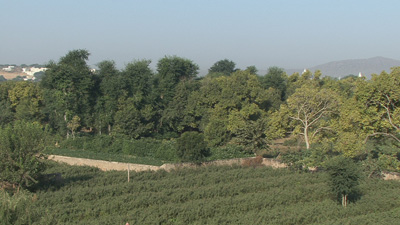
| Our
hotel was about a mile from the main drag where most of the hotels,
restaurants, and shops are. Our place was down a quiet lane, and
the view of the fields out our back window seems like it could be in
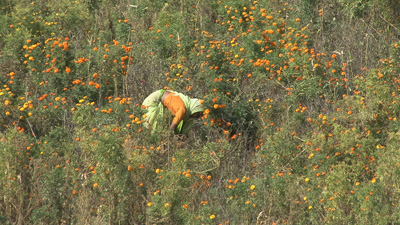
Tuscany (left). To the east of us women busily harvested a huge field
of marigolds, the flower most used in Hindu ceremonies and offerings. |
|
 |
 |
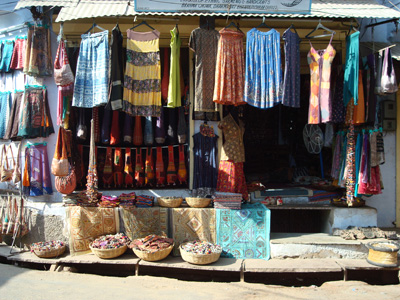
| The
town itself is a swirl of color, and someone is constantly pleading
with you to "...just see my shop." The place, along with Manali and Goa
is one of the threesome of destinations for young Israeli visitors.
Drawn here by the cheap prices and abundant bhang there is a fair sized
number of people who appear to be long termers. On the edge of town
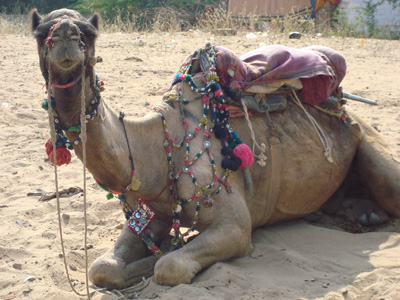
near the fairgrounds, desert people and their camels were already
beginning to arrive for the event three weeks away. |
|
 |
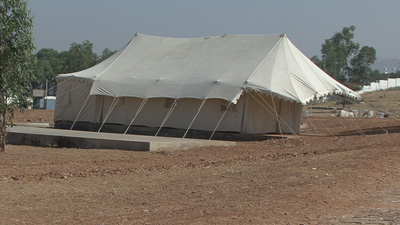 |
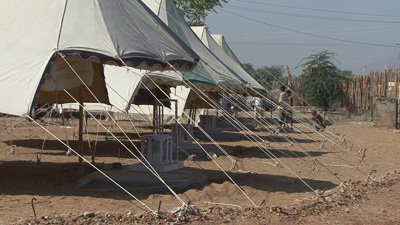
| When
we first arrive we found an area near the fairgrounds with hundreds of
porcelain toilets sitting atop concrete pits. This is called the
"tourist camp". There are another half dozen of these camps scattered
about. Two days later we found that all the roofs had been put on these
tents and that they had begun to erect the mess
tents on concrete pads. |
|
 |
 |
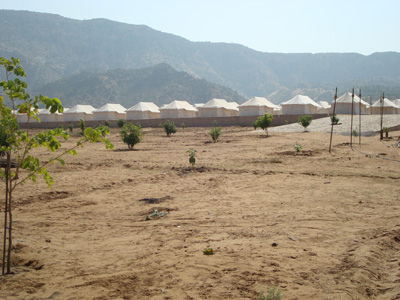
| Farther out
there are other luxury tent camps owned by hotels or by Maharajas as is
this one above. These are here permanently on concrete pads and have
toilets, running water, and beds. These rent for several hundred
dollars a night. The food, I am told, is a bit better at these. Men
were busily preparing the land in the foreground for the temporary
tents that would be erected here. This site is about six kilometers
from the fairgrounds, and during the fair the only way to get there is
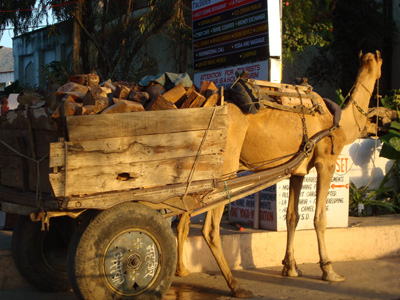
by camel carts like the one at right. When you consider the number of
people that will be there, many will find themselves waiting or walking
each day. |
|
 |
 |
 |
 |
| The largest
parcel of land is a vast expanse of dunes adjacent to the fairgrounds.
The
desert people of course will simply set up there own tents. There is no
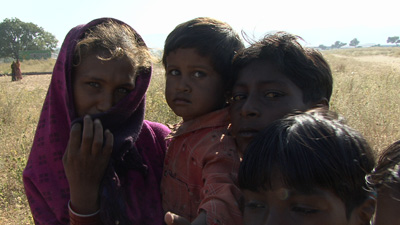
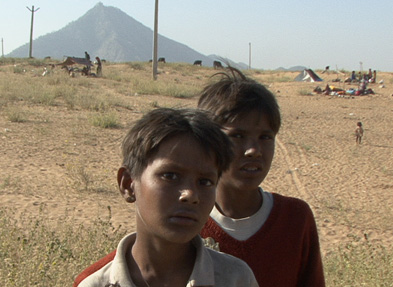
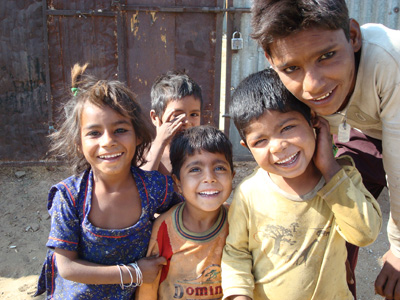
provision for toilet facilities here. Among the early arrivals the kids
would come running whenever they saw a camera. Most would try to
bargain for a few rupees or a packet of shampoo or a pen. In the end
they most were simply delighted just to see their own faces on the
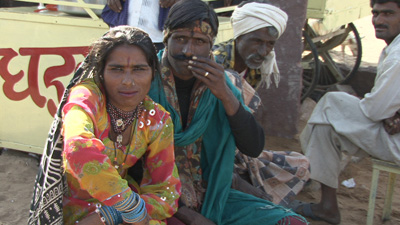
digital camera screen. The older folks like the ones top right wanted a
three rupee cup of chai. It's sad sometime to see some of these kids. I
saw many as young as 10 or 12 years old like the young girl at top left
who already have teeth stained brown from chewing tobacco or betel nut
to fend off hunger. The woman in the photo top right was only 25 years
old and looked half again that old. |
|
 |
|
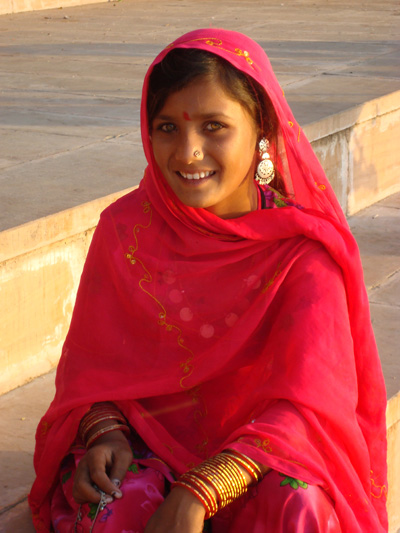
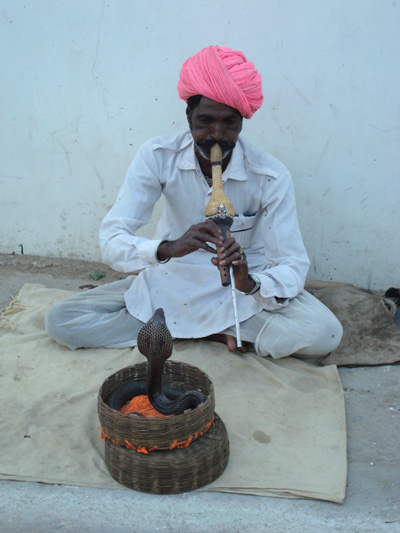
| There is a nice
spot at the eastern edge of the lake to have a drink and watch the
sunset. Even more entertaining are the people who are drawn there each
night. They range from traditional musicians, to locals in traditional
dress like the young lady below left who come to sell there wares, to
snake charmers. |
|
 |
 |
| I
just want to say a few final words about Pushkar. One of the things
that seems to have added to its appeal is that it is making real
efforts not to give in to the tourist rupee at the loss of there own
cultural values. Pushkar has posted some rules of behavior along with
warnings about potential scams and appropriate safeguards. These rules
are mostly about appropriate dress and behavior at ghats and temples,
also the removal of all shoes and leather goods at those same places.
They also caution against open displays of affection. Pushkar is also
vegetarian by law, and the eating of meat or eggs, and alcohol is also
strictly prohibited. If someone had told me before coming here that I
would eat vegetarian for an entire week and then miss the food when I
left I would have said they were crazy, but these were among the best
meals we have had, and the produce is phenomenal. |
|


