Madaba is
another short day trip from Amman that we were able to combine with a
trip to nearby Mt. Nebo, and The Dead Sea. Madaba is home to some of
the finest mosaics in Jordan. Although under influence of the Romans
since the early part of the 2nd century AD the majority of the mosaics
here date back to the Byzantine era (3rd to 7th centuries AD).
Following the devastation of Madaba by an 8th century earthquake, the
mosaics had been lost to history until the 19th century when thousands
of Christians, fleeing a bloody conflict with Muslims, migrated to
Madaba from Karak south of here. The new residents discovered the
mosaics as they began to excavate to build new homes, and churches.
Madaba today continues to be home to a large christian community.
|

|

|
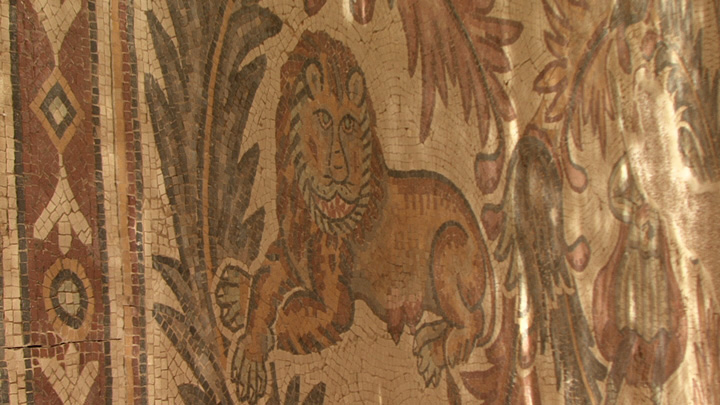
Although Madaba
boasts dozens of sites with stunning mosaics, perhaps the most famous
is the Greek Orthodox Church of St. George. Beyond its unassuming
exterior its modest sacristy is somewhat of a change in a Muslim
country that shuns the image of living beings in its art.
|
|
|
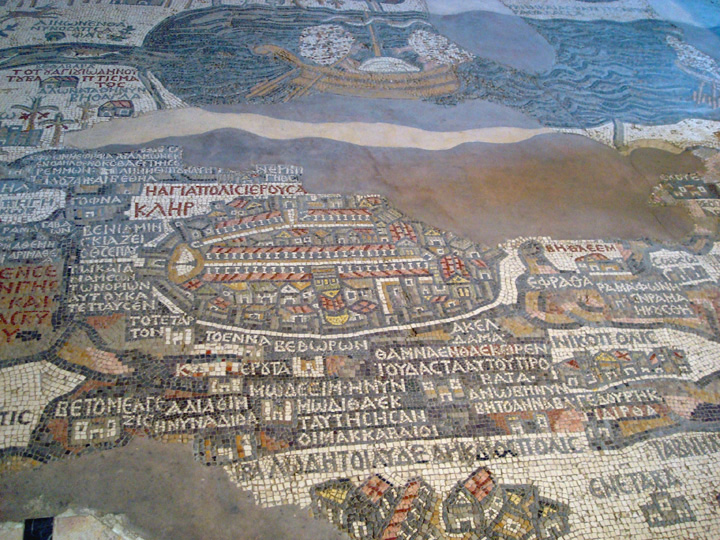
The
real attraction at St. George's though is the preserved segment of the
floor mosaic that is a detailed period map of the Holy Land. The
captions and place names are written in Greek. The map is said to be
historically and physically accurate. Below is an image of an angel
that graces the space between two arched entries to the vestibule.
|

|

|
The Madaba
Archaeological Park encompasses several buildings. This detailed floor
in the Church of the Virgin was originally part of a 6th century
mansion. Walkways surround many of the larger remaining mosaics such as
this one to facilitate viewing while preserving the works from the
ravages of the thousands of tourists who visit.
|

|

|
The Madaba
Museum, housed in a number of old residences and an ancient chapel, is
host to still more fine examples of the craft. The image at right is
thought to be Bacchus and Ariadne. Although the latter wears, in
addition to cymbals on her hands and feet, what appears to be a
unitard, guidebooks still refer to her image as "naughty". Madaba is
also home to several mosaic schools that work to promote and preserve
the art.
|
|
|
Yet another
outstanding venue for mosaics in the region is Mt. Nebo about nine
kilometers outside of Madaba. Mt. Nebo is the place where Moses finally
saw the promised land. Several large mosaics are for now
kept under a tent like structure just outside of Mt. Nebo's tiny
museum. Unfortunately, the structure does allow in some mottled
sunlight which makes photography a bit difficult. Still the images
above and below show some of the amazing detail.
|

|

|
 |

|
The
hazy and polluted desert view from Mt. Nebo towards the Promised Land.
The darker area at the center of the photo at left is the desert oasis
Jericho roughly six kilometers away. The grainy telephoto at right
brings it a little closer.
|

|

|
Above, inside
the museum at Mt. Nebo is this Roman milestone found nearby. The
inscription at right clearly places it within the realm of the
Emperor Caesar.
|

|
No trip to this
area would be complete without a trip to the dead sea and the
obligatory float. Many Muslims, similar to what we encountered in
India, enjoy the beach and the sea fully clothed. There are no such
restrictions on visitors.
|

|
 |
 |
 |
With
salinity six times what it is in the ocean floating in the Dead Sea is
hard to describe. One can almost 'sit up' in the water. The difference
is most noticeable when you go to stand up from the floating position.
It is as though your legs don't want to go down. If you can find a soft
spot in the sandy and rocky bottom, you can dig down for some of the
mineral rich mud. The mud really does leave your skin feeling softer,
and a bar of "mud soap" in local gift shops can go for as much as
twenty-five dollars. In the photo at bottom right, you can see the size
of the salt crystals that line the shore.
|

|
It
turns out that this hispanic guy who taught us about the mud thing was
working at the hotel where we were staying. Originally from Milwaukee,
he has been living in Amman for more than a year.
|

|

|
|
|