| Petra, near the
town of Wadi Musa, is understandably the most visited sight in all of
Jordan. Its most famous sights, the Siq, a breathtaking narrow
sandstone canyon, and Al-Khazneh or The Treasury were made famous in
one of the early Indiana Jones movies. But these are only two of the
more than eight hundred tombs, palaces, theaters, and temples carved
into Petra's sandstone canyons and mountainsides that vie with the
swirling colors on those same rock surfaces for the attention of
awestruck tourists. Referred to as the "Rose Red City", Petra escaped
the notice of Westerners for close to a millennium. Petra, which comes
from the Greek word for rock, is the work of a nomadic Arab tribe known
as the Nabateans that settled the area in the second century BC. The
location was selected for its concealment as the Nabateans guarded the
trade routes that they controlled. During the first and second
centuries AD Petra came under Greco-Roman influence and the
area's few structures that are freestanding constructions reflect that
influence. The majority of the structures though are not constructions
but rather they are carvings. Guide books point out that only about 5%
of of the structures have been excavated. Although the sources of
wealth eventually dwindled and outside influence receded, Petra
continued to prosper in relative seclusion. Its last major contact with
the outside world is traced to the time of the Crusades. Then, from the
twelfth century until the early nineteenth century it was forgotten by
the western world until it was "discovered" in the early 1800s by a
Swiss explorer. It almost seems as though its inhabitants could foretell the inundation their beautiful home would endure under the hordes of outsiders that flock here daily to marvel at this magical place. The fact is that until the 1980s, many of the caves here continued to be homes for local B'doul Bedouin families until the government relocated them to Umm Sayhoun, a new settlement of block construction a few miles from Wadi Musa. Many continue to spend their days inside the site selling souvenirs and water, with some acting as guides or providing horses or donkeys for access to some of the higher places. |
||||
 |
||||
| For walk-in
ticket holders, a solitary guard in traditional military garb, greets
visitors. Nearby, there is a parking lot that holds scores of buses for
the seemingly endless stream of French, Italian, Spanish, and German
package tours that come to visit. |
||||
 |
||||
|
At the ticket counter Karen
quickly pointed out this scene in time for me to snap it. As this young
lady considers the older visitor, it is interesting--perhaps only to
us--because it embodies something that we have been commenting on
throughout the past year. Despite advisories in every guide book we
have seen, as well as countless pamphlets and brochures that outline
the simplest of guidelines for proper attire in many of Asia's most
sacred places, we consistently see European travelers show up in Hindu,
Buddhist, Jane, and Islamic temples and holy places ignoring the pleas
to consider local cultural norms. The suggestions are almost always the
same for both men and women--covering of the shoulders, and no shorts
or mini-skirts. Fortunately for these tourists, all but the most holy
of sites tactfully look the other way to these fashion faux pas, some places will even
offer to lend head covering or shirts where required. We might point
out that in our own experience we have witnessed the Vatican guard
politely but firmly deny admittance to similarly attired visitors at
places like the Sistine Chapel and St. Peters Basilica.
|
||||
 |
||||
| A little over a
half mile from the entrance to Petra, the first major structures one
reaches is the Obelisk Tombs and the Bas As-Siq Triclinium. Although
somewhat modest in scale in comparison, it's an important monument by
virtue of the variety of influences represented including Greco Roman,
Egyptian, an Nabatean. The triclinium was an important room in upper
class Roman homes. Literally a dining room with a table surrounded on
three sides by benches. The name--Bas As-Siq-- translates as entrance
to the Siq, and it stands opposite a dam which channeled run off away
from the Siq. The Siq was not formed, as it would appear, by erosion,
but rather by tectonic activity. Near the entrance to the one and a
quarter kilometer long gorge, the Bedouin boy below tended his small
herd of goats, although it looked a lot more like play. |
||||
 |
||||
|
||||
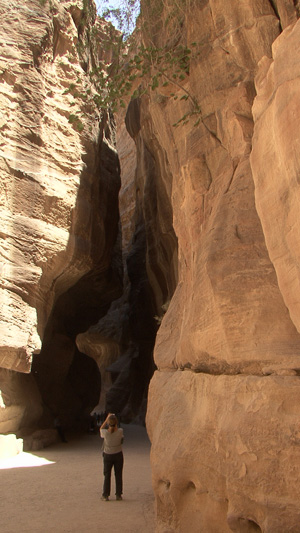
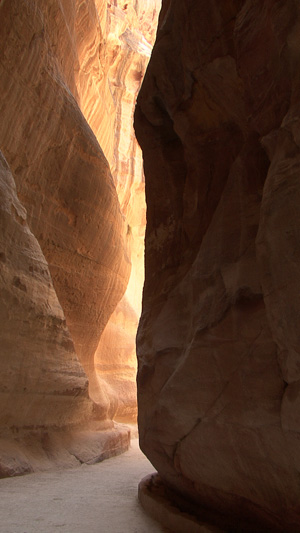
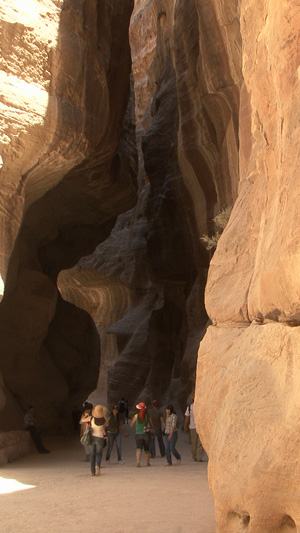
| In
its length of some twelve football fields, the Siq is anywhere from
fifty feet to one hundred meters in height, and as wide at the top as
on hundred feet and as narrow as one meter. Visible in the center photo
is a channel carved into the rock near the base. These channels running
through parts of the Siq actually held a system of pipe created to
carry water fed from side canyons through the Siq without contributing
to erosion. The floor of the Siq in some areas is still sandy while in
other parts the original cobblestones, each about the size of a small
microwave, remain. In most of the Siq though, the floor has been paved
to accommodate the hordes of people who visit. The constant stream of
people, even now in what is considered the low season makes that
pristine photo all the more elusive. Light plays its own games with the
photographic process. The funniest thing overheard in our two days
here----at one of the widest parts of the Siq a french woman asked of
her guide "...so, this was all here, and they just made it wider?" |
||||
 |
 |
|||
| Although
there are a number of votive niches, some carved stairways leading up
feeder gorges, and the occasional bas relief like this Arab soldier at
left, they are actually fairly sparse within the Siq. It is almost as
if the Nabateans were aware that their own efforts paled in comparison
to the handiwork of whatever force created the Siq itself. The soldier
at left was determined to be Arab by which side his cloak was tied and
the straps on his sandals. |
||||
 |
 |
|||
| After more than
a kilometer in the Siq one rounds a narrow corner and comes upon what
is probably the most photographed spot in all of Jordan. The end of the
Siq opens onto Al-Khazneh, the Treasury, made famous by Harrison Ford.
In addition to the Treasury's massive inner hall the structure also has
a basement complex of tombs. It is all but impossible to get that
really pristine photo of the Treasury. Even though the site opens at 6
AM, and you might get a shot relatively free of the unconscious
tourists who linger directly in front of each and every structure
convinced that he whole world really wants to have them in the photo,
the early morning light plays across the front diagonally in a range of
f-stops beyond the ability of most cameras. Someone who is good in the
darkroom or with PhotoShop could pull out a nice photo, but those
talents are still a bit beyond my skill set. We did however return
early the next day because it is next to impossible to take everything
in in one day, so you will see what I mean. |
||||
 |
 |
|||
| Once you exit
the Siq at the Treasury, the sun becomes relentless. Camel drivers wait
in the small patch of shade of an overhang waiting to ferry those too
lazy to walk to the next concentration of structures, the Street of
Facades and the Royal Tombs. I'm not certain of the name of the tomb at
right but it towers above the Wadi (valley) below. |
||||
 |
||||
| As amazing as
the structures here are, they at best share the spotlight with the
beauty of the rock itself. You find yourself so awed by the scale of
the work that has been done here that you are often ignoring how
amazingly beautiful the place is in its own right. |
||||
 |
||||
| The Urn Tomb
above, and the Palace Tomb below are both part of a complex known as
The Royal Tombs. Although showing the ravages of erosion, they once
rivaled the Treasury in beauty and complexity. Today their biggest
challenge are the tourists that feel compelled to climb all over things. |
||||
 |
||||
 |
||||
| Above, the
Street of Facades were actually Nabatean tombs. Petra at its peak was
home to tens of thousands of inhabitants, but no evidence exists that
any of the structures here were dwellings. The Roman Theater below was
actually carved in the first century AD by local Nabatean artisans who
copied nascent Roman influence in the region. |
||||
 |
||||
 |
||||
| There are
two popular hikes into the mountains that surround the valley. To
complete our first day we decided to visit Ad-Deir, The Monastery,
perhaps the second most visited site in Petra. There is some question
whether the Monastery was a tomb or a temple, but it is known to have
been an important pilgrimage site. There are some 800 steps carved into
the rock on the more than one mile hike to the top. In the photo below,
the structures carved on the rock face on the opposite side
of the valley below are just visible. |
||||
 |
||||
| The
reader may be tired of looking at rocks, but you are going to have to
click on the next button which takes you to day two and at least skim
the page, if you are interested in moving on. |
||||
 |
||||
 |
||||
 |
||||